

Alternatives to Side Mount Drawer Slides
Table of Contents
- Why Choose Alternatives to Side Mount Drawer Slides
- Undermount vs Side-Mount Drawer Slides: Key Differences
- Drawer Slide Clearance Requirements for Different Systems
- Soft Close and Push-to-Open Undermount Runners
- Wooden Drawer Runners as a Traditional Alternative
- Installation Differences: Undermount, Centre-Mount, and Side-Mount
- Comparison Table: Undermount, Centre-Mount, and Side-Mount Options
- Which Alternative Should You Choose
- Frequently Asked Questions
Last Updated: October 20, 2026
Why Choose Alternatives to Side Mount Drawer Slides
Side-mount drawer slides have dominated for decades, but they're not always the best fit for modern cabinetry. Alternatives to side mount drawer slides offer distinct advantages depending on your project requirements, cabinet design, and the finish you're after.
The real question isn't whether alternatives exist, they do. It's whether they solve problems that side-mount systems create. Space constraints, aesthetic concerns, and load capacity all play a role. At FixFit, we work with joiners, cabinet makers, and fit-out companies daily. Undermount and centre-mount systems can deliver cleaner aesthetics, better load distribution, and easier installation in many scenarios.
Understanding when to move beyond side-mount runners requires knowing what each system actually delivers. This guide breaks down the practical differences, installation realities, and when each option makes sense for your specific build.
Undermount vs Side-Mount Drawer Slides: Key Differences
Undermount runners sit beneath the drawer box, completely concealed when the drawer closes. Side-mount slides attach to the interior sides of the cabinet frame. The difference goes far deeper than appearance alone.

Space and Aesthetics
Undermount systems reclaim interior drawer space because the hardware sits underneath rather than eating into the usable width. For a 500 mm drawer, side-mount runners consume roughly 20-30 mm of internal width on each side. That's 40-60 mm of lost storage capacity, significant for shallow drawers or narrow cabinets.
Aesthetically, undermount runners create a seamless look. There's no visible hardware, no unsightly brackets, and no gaps between the drawer front and cabinet frame. This matters enormously for contemporary kitchens, high-end joinery, and bespoke furniture where the client is paying for precision and refinement.
Side-mount slides remain visible when drawers are open, which works fine for utility spaces but can cheapen the overall impression of premium cabinetry. Many designers now specify undermount systems specifically to avoid that industrial appearance.
Load Capacity and Durability
Load capacity varies significantly between systems. Undermount runners typically support 25-35 kg per pair, depending on the model and extension type. Side-mount slides often handle similar weights.
Steel construction matters for both types. Zinc-plated finishes resist corrosion in damp environments like kitchens and bathrooms. Ball-bearing slides outperform friction-based runners in durability and smoothness, particularly under repeated use.
For professional installations, soft-close mechanisms add another layer of durability. They reduce impact stress on the runners and drawer box by decelerating the drawer as it closes. This extends the lifespan of both the hardware and the cabinet structure.
Drawer Slide Clearance Requirements for Different Systems
Every drawer slide system has specific clearance demands. Getting this wrong results in binding, misalignment, or inability to install the runners at all.
Undermount runners typically require 10-16 mm of clearance beneath the drawer box. This space accommodates the runner profile and adjustment mechanisms. Cabinet depth becomes critical, shallow cabinets (under 400 mm) sometimes can't accommodate undermount systems without custom modifications.

Side-mount slides need clearance on both the left and right interior walls of the cabinet frame. Standard side-mount runners require roughly 15-20 mm of side clearance. This is usually straightforward in standard cabinetry but becomes problematic in narrow cabinets or when the cabinet frame isn't perfectly parallel.
Centre-mount runners sit on the bottom centre of the cabinet and support the drawer from underneath via a single centre rail. They require less side clearance than side-mount systems and work well in narrow cabinets. However, they limit drawer width to around 600 mm before additional support is needed, and they're less common in modern cabinetry.
The practical lesson: measure your cabinet interior dimensions carefully before specifying any system. Undermount runners need depth; side-mount systems need width; centre-mount systems need length. Choosing the wrong system wastes time and money on returns or modifications.
Soft Close and Push-to-Open Undermount Runners
Soft-close technology has become standard in premium cabinetry. It's no longer a luxury feature, it's an expectation.
Soft-close undermount runners use hydraulic damping to decelerate the drawer as it closes, eliminating the bang of a slamming drawer. The mechanism engages in the final 50-100 mm of travel, providing smooth deceleration without requiring the user to do anything different. It simply works.
Push-to-open systems take this further. A light touch on the drawer front triggers a spring-loaded mechanism that opens the drawer automatically. There's no visible handle, no pull required, just press and the drawer glides open. This creates an exceptionally clean aesthetic and is increasingly popular in contemporary kitchen design.
FixFit supplies soft-close and push-to-open undermount runners in multiple sizes and load capacities. The Drawer Runners Soft Closing Full Extension Undermounting option at £10.94 per pair delivers soft-close performance with full extension capability and 35 kg load capacity. For 18 mm board applications, the Drawer Runners Soft Close & Push to Open 18MM Board Runner at £27.54 combines both technologies in a single system.

The trade-off: soft-close and push-to-open mechanisms add cost and complexity. They're worth it for high-end projects but may be overkill for utility spaces or budget-conscious renovations. Standard soft-close undermount runners can cost more than basic side-mount slides.
Wooden Drawer Runners as a Traditional Alternative
Before metal ball-bearing slides became standard, wooden runners dominated. They're still relevant in period renovations, traditional joinery, and heritage cabinetry restoration.
Wooden runners consist of a solid timber rail (typically hardwood like oak or beech) mounted to the cabinet side, with a corresponding wooden slide attached to the drawer. The drawer slides along the wooden rail via gravity and friction.
The advantages are real for the right application. Wooden runners are repairable, if they wear, they can be planed down or replaced without replacing the entire drawer. They're sympathetic to period cabinetry and match authentic restoration requirements.
Drawer Runners Soft Closing Full Extension Undermounting →
The disadvantages are equally clear. Wooden runners wear faster than metal slides, particularly under heavy use. They swell and stick in humid environments like kitchens and bathrooms. They require regular maintenance, waxing, planing, and adjustment. They don't offer soft-close functionality or full extension capability. Load capacity is lower than modern metal systems.
For new work, wooden runners are rarely specified unless the project specifically calls for a traditional aesthetic or the client insists on period authenticity. For restoration projects, they're essential. For everything else, metal alternatives deliver better performance with less maintenance.
Installation Differences: Undermount, Centre-Mount, and Side-Mount
Installation complexity varies dramatically between systems, and this directly impacts project timelines and labour costs.
Side-mount installation is straightforward. The runners attach to the interior sides of the cabinet frame using screws, typically 3-4 fixing points per side. Alignment is relatively forgiving because the drawer sits between two side rails.
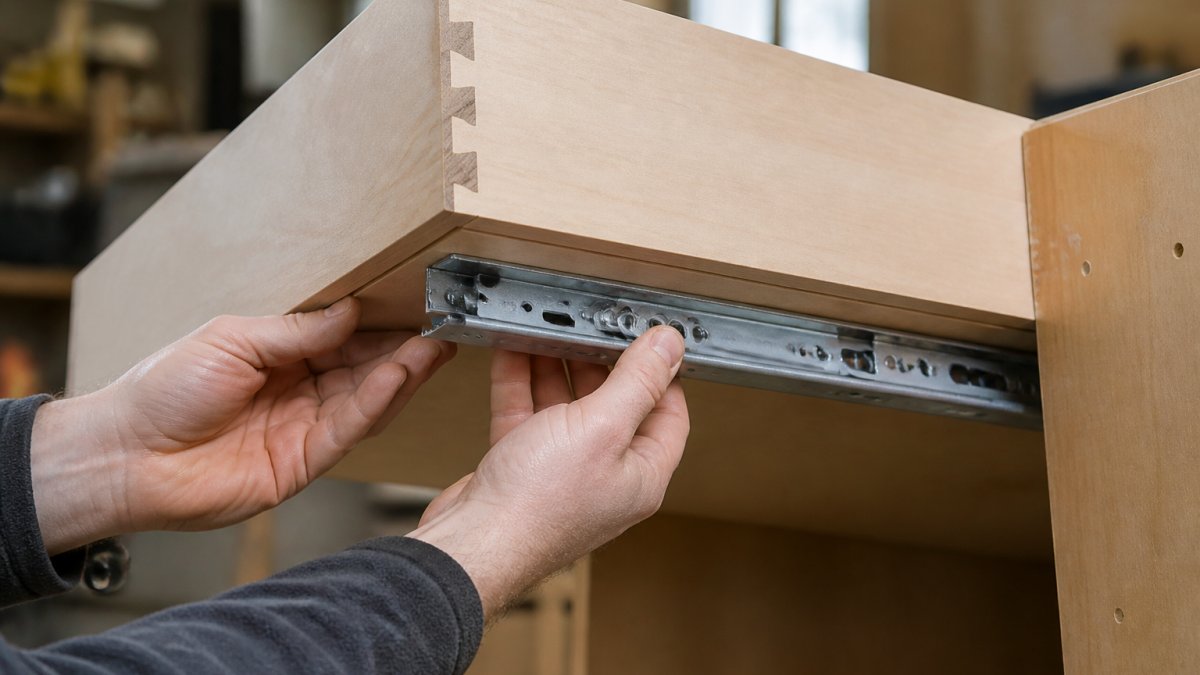
Undermount installation requires more precision. The runners mount to the underside of the drawer box and the bottom of the cabinet frame. This demands accurate measurement and careful alignment because any misalignment shows immediately in drawer performance.
Most undermount systems include adjustment mechanisms, typically screws for height, depth, and side-to-side positioning. These allow fine-tuning after installation, which is essential because perfect alignment on the first try is rare.
Centre-mount installation falls between the two. The centre rail mounts to the cabinet floor, and the drawer attaches via a single support point. This is faster than undermount installation but requires the cabinet bottom to be perfectly flat and level.
The practical reality: undermount systems can take longer to install. Side-mount systems can be faster. For professional work, the extra time on undermount installation can pay dividends in customer satisfaction.
Many joiners initially resist undermount systems because they're unfamiliar. The adjustment mechanisms can make getting perfect alignment straightforward.
Comparison Table: Undermount, Centre-Mount, and Side-Mount Options
| Feature | Undermount | Centre-Mount | Side-Mount |
|---|---|---|---|
| Visible Hardware | No (fully concealed) | Minimal (centre rail visible) | Yes (side brackets visible) |
| Internal Space | Maximum (no side rails) | Good (centre rail only) | Reduced (side rails consume space) |
| Load Capacity | 25-35 kg | 20-30 kg | 20-35 kg |
| Installation Time | 15-20 min per drawer | 10-15 min per drawer | 5-10 min per drawer |
| Adjustment Difficulty | Moderate (3-axis adjustment) | Easy (primarily height) | Easy (primarily side-to-side) |
| Soft-Close Options | Yes (standard) | Limited | Limited |
| Cabinet Depth Required | 350+ mm | 350+ mm | 250+ mm |
| Best For | Contemporary, premium finishes | Budget-conscious, narrow cabinets | Utility spaces, retrofits |
| Cost per Pair (Estimate) | £10-28 |
Which Alternative Should You Choose
The decision depends on three factors: project type, cabinet dimensions, and budget.
Choose undermount if the project is contemporary, high-end, or bespoke. The superior aesthetics and full extension capability justify the additional installation time and cost. Most premium kitchens and designer furniture now default to undermount systems.
Choose centre-mount if the cabinet is narrow (under 600 mm internal width) and budget is a consideration. Centre-mount runners work reliably in tight spaces where side-mount systems won't fit.
Choose side-mount for utility spaces, retrofits, or when installation speed is critical. They're reliable, affordable, and require minimal adjustment. For a garage workshop, storage room, or budget renovation, side-mount slides deliver solid performance without overthinking it.
Budget matters, but it's not the whole story. An undermount runner from FixFit can offer good value. The cost difference can be meaningful in a 10-drawer kitchen but negligible in the context of a full renovation budget.
The real differentiator is the project context. Specify what the client actually needs rather than defaulting to what you've always used. Modern cabinetry increasingly expects undermount systems, soft-close mechanisms, and full extension capability.
Choosing alternatives to side mount drawer slides isn't about abandoning a proven system, it's about matching the right hardware to the right project. Undermount runners deliver superior aesthetics and performance for premium work.
At FixFit, we stock undermount, centre-mount, and side-mount runners from trusted brands like GTV, ensuring you have access to the right system for every project.
Frequently Asked Questions
What are the main alternatives to side-mount drawer slides?
The primary alternatives to side-mount drawer slides are undermount runners, centre-mount slides, and wooden drawer runners. Undermount systems mount beneath the drawer and offer a cleaner aesthetic with no visible hardware. Centre-mount slides attach to the centre of the drawer base and work well for narrower drawers. Wooden runners provide a traditional option for heritage projects or bespoke cabinetry. Each system suits different cabinet designs, load requirements, and installation preferences.
Are undermount drawer slides better than side-mount slides?
Undermount drawer slides offer distinct advantages over side-mount options: they provide a cleaner, more professional appearance with no visible hardware, they maximise usable space inside the drawer, and they can feel more refined in high-end cabinetry. However, side-mount slides often cost less and can handle certain applications effectively. The better choice depends on your project requirements, budget, and aesthetic priorities. For premium finishes and modern kitchens, undermount systems can deliver excellent results.
How much clearance do undermount drawer slides need?
Undermount drawer slides require specific clearance to function properly. Most undermount systems require specific clearance to function properly. Board thickness matters, and vertical clearance between the drawer box and cabinet frame typically requires adjustment for proper alignment. Always check the manufacturer's specifications for your chosen runner system to ensure adequate clearance in your cabinet design.
Can you use wooden runners instead of drawer slides?
Yes, wooden runners are a viable alternative, particularly for traditional cabinetry, heritage projects, or bespoke furniture. Wooden runners consist of timber guides attached to the cabinet sides and drawer, allowing the drawer to slide on wood-to-wood contact. They work well for lighter-duty applications and offer an authentic aesthetic for period-style work. However, they require more maintenance than modern metal slides, and generally have lower load capacity. Metal undermount or side-mount slides are often preferred for high-traffic kitchen and bathroom applications.
What is the difference between undermount and side-mount drawer slides?
Undermount slides mount beneath the drawer box, remaining completely hidden when the drawer is closed, whilst side-mount slides attach to the interior sides of the cabinet and drawer. Undermount systems offer superior aesthetics and maximise internal drawer space but typically cost more and require precise installation. Side-mount slides are more affordable, easier to install, and work in a wider range of cabinet configurations, but the hardware is visible and takes up side space. Your choice depends on budget, cabinet design, and whether visible hardware is acceptable for your project.