

How to Adjust Soft Close Cabinet Hinges: 2026 Guide
Table of Contents
- What You'll Need Before You Start
- Soft Close Hinge Adjustment Screw Functions Explained
- Step 1: Diagnose the Door Problem Before Touching a Screw
- Step 2: Adjust Soft Close Cabinet Hinges for Height, Depth and Sideways Alignment
- Best Tools for Cabinet Hinge Adjustment
- Troubleshooting Cabinet Door Alignment Problems
- Common Mistakes to Avoid
- Frequently Asked Questions
Last Updated: September 19, 2026
What You'll Need Before You Start
Knowing how to adjust soft close cabinet hinges is a simple job once you know which screw does what. Most doors that sag, rub or sit proud need nothing more than a quarter turn in the right place. This guide from FixFit walks you through the whole process, from diagnosis to final tweak.
Before you pick up a screwdriver, clear a space and gather a few basics.
- A cross-head screwdriver that fits the screw heads properly
- A small spirit level, or a straight edge if you have one
- A pencil for marking reference points
- A torch or phone light for dark cabinet interiors
- Masking tape to protect the door face if you are working close to the edge
Check the hinge brand first. Blum, Hafele, GTV, Sugatsune and Tutti all use similar adjustment systems, but the screw positions can vary slightly. If you know the brand, you can usually find the exact adjustment guide on the maker's site.
Soft Close Hinge Adjustment Screw Functions Explained
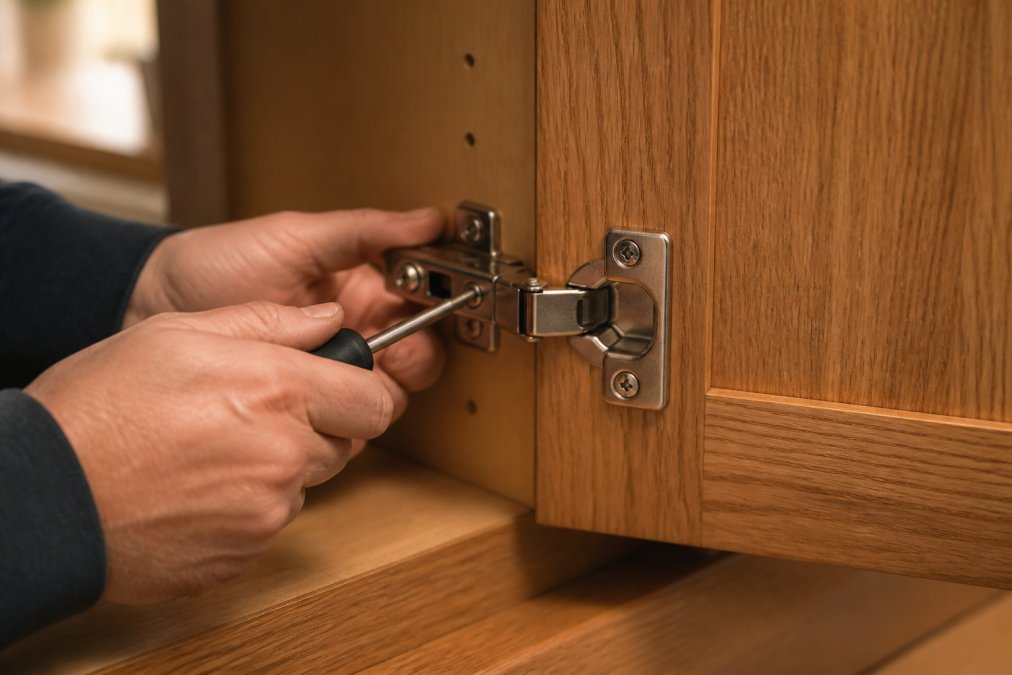
Soft close hinge adjustment screw functions are simple once you know the layout. Almost every concealed cabinet hinge has three screws, and each one moves the door in a different direction. Get to know them and the job becomes quick and predictable.
The Three Screws That Control Every Movement
Each screw does one job. Learn the three and you can fix almost any door problem.
- Depth screw: Moves the door towards or away from the cabinet frame. This controls the gap between the door and the carcass.
- Sideways screw: Slides the door left or right along the mounting plate. This lines up the door with its neighbours.
- Height screw: Raises or lowers the door on the plate. This fixes doors that drop or catch at the top and bottom.
On most hinges, the depth screw sits on the hinge arm itself. The sideways and height screws sit on the mounting plate fixed to the cabinet. Turn clockwise to tighten, anticlockwise to loosen.
The soft close mechanism itself is not adjustable on most hinges. If the door slams, that is a worn damper, not a screw setting. We will cover that in the troubleshooting section.
Step 1: Diagnose the Door Problem Before Touching a Screw
Diagnosis comes before adjustment. A door that rubs at the bottom needs a different fix from one that gaps at the top. Working out the fault first saves you from making a small problem worse.
Open and close the door slowly. Watch where it catches, where it gaps, and how it sits against its neighbours.
- Door rubs at the bottom: the door has dropped. You need the height screw.
- Door gaps at the top: the door has dropped the other way, or the cabinet is out of level.
- Door sits proud of the frame: the depth screw is set too far out.
- Door sits too far in: the depth screw needs turning the other way.
- Door is out of line with the next door: the sideways screw needs a small turn.
Check the hinges themselves too. A loose hinge screw will undo any adjustment you make. Tighten every fixing screw on the plate and arm before you start.
Step 2: Adjust Soft Close Cabinet Hinges for Height, Depth and Sideways Alignment
To learn how to adjust soft close cabinet hinges, turn the correct screw a quarter turn at a time and test the door after each turn. Small movements are the key. A full turn is usually far too much.
Start with height. Turn the height screw to raise or lower the door until the gap at the top and bottom is even. Test the door after every quarter turn.
Next, set the depth. Turn the depth screw until the door face sits flush with the frame and its neighbours. A straight edge held across the front shows you when it is right.
Finally, set the sideways position. Turn the sideways screw until the gap between doors is even. Aim for a gap the width of a matchstick, roughly 2mm, which is standard for most kitchen units.
Fixing Doors That Rub, Gap or Sit Proud
A door that rubs usually needs a small height tweak. Turn the height screw a quarter turn and test again.
A door that gaps at the top often needs the same fix in the other direction. If the gap stays after two or three turns, the cabinet itself may be out of level. Check with a spirit level before you keep adjusting.
A door that sits proud needs the depth screw turned in. A door that sits too far in needs it turned out. Make one change at a time and check the result.
Best Tools for Cabinet Hinge Adjustment
The best tools for cabinet hinge adjustment are a properly sized cross-head screwdriver and a small spirit level. You do not need a big kit. Most adjustments take less than ten minutes per door.
A few extras make the job easier and more accurate:
- A stubby screwdriver for tight cabinet interiors
- A Pozidriv bit if the hinge screws are Pozi type, which many European hinges use
- A small torpedo level for checking the cabinet carcass
- A soft cloth to protect the door face while you work
Cheap screwdrivers with soft tips will round off the screw heads. Use a driver that fits the screw properly and keep firm downward pressure as you turn.
If you are fitting new hinges rather than adjusting old ones, buy from a supplier who stocks the brands the trade trusts.
Troubleshooting Cabinet Door Alignment Problems
Troubleshooting cabinet door alignment problems starts with checking whether the issue is the hinge or the cabinet. A door that will not line up often points to a deeper problem than a screw setting.
Work through these checks in order:
- Door still rubs after adjustment: check the cabinet is level and square.
- Door will not stay in place: check the hinge plate is tight to the carcass.
- Soft close has stopped working: the damper is worn, not the screw setting.
- Door drops again within days: the hinge screws may be stripped or the fixing holes worn.
When Adjustment Won't Fix It
Some problems need new parts, not a screwdriver. If the soft close has stopped working, the damper inside the hinge has worn out. No amount of turning will bring it back.
Blum hinge adjustment guidance
Common Mistakes to Avoid
The biggest mistake is turning a screw too far. A quarter turn moves the door more than most people expect. Turn in small steps and test after each one.
Other common errors:
- Adjusting a door before tightening the hinge fixings
- Using the wrong screwdriver and rounding off the screw heads
- Adjusting depth when the real problem is height
- Forcing a screw past its limit, which strips the thread
| Problem | Screw to Turn | Direction | Check After |
|---|---|---|---|
| Door rubs at bottom | Height | Raise door | Quarter turn |
| Door gaps at top | Height | Lower door | Quarter turn |
| Door sits proud | Depth | Turn in | Quarter turn |
| Door sits too far in | Depth | Turn out | Quarter turn |
| Doors out of line | Sideways | Slide left or right | Quarter turn |
| Soft close not working | None | Replace hinge | N/A |
Frequently Asked Questions
Why are my soft close hinges slamming shut?
If a soft close hinge slams rather than cushioning the door, the damping mechanism has usually failed or the hinge has been over-adjusted. Check the adjustment screws first: if the door sits too far from the cabinet, the soft close function cannot engage properly. Turn the depth screw clockwise to bring the door closer to the frame. If the door still slams after correct adjustment, the hinge itself needs replacing.
Can you adjust the speed of soft close hinges?
Most soft close hinges do not have a speed dial. The closing speed is set by the internal hydraulic damper and cannot be changed by turning a screw. What you can adjust is how the door meets the cabinet: correct depth and side alignment let the damper work as designed. If the door closes too quickly even when aligned, the hinge is worn and should be swapped for a new one.
How do I align cabinet doors with soft close hinges?
Start with the side adjustment screw to close or widen the gap between doors. Then use the height screw to level the door top and bottom. Finish with the depth screw to bring the door face flush with the cabinet frame. Make quarter-turn adjustments and close the door to check before turning further. For a full run of doors, align the middle door first and work outwards so the gaps stay even across the whole unit.
How do I know if my hinge is broken or just needs adjustment?
A hinge that needs adjustment will still hold the door in position but the door sits crooked, rubs, or gaps unevenly. A broken hinge shows different symptoms: the door drops when opened, the soft close function stops working entirely, or you can see cracks or play in the hinge arm. Try the adjustment screws first. If turning them makes no difference, or the hinge feels loose at the mounting plate, replace it. Broken hinges cannot be repaired, only swapped.