

How to Choose Cabinet Hinges: A 2026 Guide
Table of Contents
- Start With Your Door Overlay and Cabinet Type
- Types of Cabinet Hinge Overlays and What They Change
- Measuring Cabinet Door Hinge Bore Size Correctly
- Matching Hinges to Door Weight, Material and Use
- Choosing the Right Mounting Plate and Hinge Arm
- How to Fix Misaligned Cabinet Doors After Fitting
- Common Mistakes When Choosing Cabinet Hinges
- Frequently Asked Questions
Last Updated: September 21, 2026
Start With Your Door Overlay and Cabinet Type
Getting the overlay wrong is the single most common reason a hinge order has to go back. Overlay is the distance your cabinet door sits past the carcass opening on the hinge side, and it decides which hinge arm and mounting plate you need before anything else matters. Measure it first, then choose.
At FixFit, we supply cabinet hinges and fittings to joinery workshops, fit-out contractors and DIY renovators. The answer to "which hinge fits this door?" always starts with the overlay, not the brand.
Cabinet hinges are the mechanical fittings that connect a cabinet door to its carcass, controlling how far the door opens, how it closes, and how much of the cabinet face it covers. Three overlay types cover almost every kitchen and furniture build.
Full Overlay, Half Overlay and Inset Doors
Full overlay means the door covers the entire carcass edge, leaving only a small gap between adjacent doors. It is the standard for modern kitchens because it hides the frame completely.
Half overlay splits the coverage: two doors share one central partition, each covering roughly half of it. You will see this on cabinets where doors meet in the middle without a visible divider.
Inset doors sit flush inside the cabinet opening, with the door face level with the carcass. Inset hinges cost more and demand tighter tolerances, because any error in the bore position shows immediately as a misaligned door.
Measure your overlay from the cabinet edge to the outside edge of the closed door. Write the figure down. Every plate and arm decision downstream depends on it.
Types of Cabinet Hinge Overlays and What They Change
Overlay type determines the crank, or offset, built into the hinge arm. Get the crank wrong and the door will bind, sit proud, or fail to close against the carcass.
A straight arm suits full overlay. A cranked arm pulls the door back toward the cabinet, which is what half overlay and inset doors need. The plate underneath adds its own height adjustment, so arm and plate work as a pair.
| Overlay Type | Door Position | Typical Arm | Best For |
|---|---|---|---|
| Full overlay | Covers whole carcass edge | Straight | Modern kitchens, clean lines |
| Half overlay | Covers half the partition | Cranked | Shared partitions, paired doors |
| Inset | Flush inside opening | Cranked, deeper | Traditional and bespoke furniture |
If you are unsure which category your doors fall into, a cabinet angle template removes the guesswork on angled runs. The Blum official hinge and fitting documentation sets out arm and plate combinations by overlay, and it is worth checking before you commit to a bulk order.
Measuring Cabinet Door Hinge Bore Size Correctly
Measuring cabinet door hinge bore size correctly means finding the diameter of the cup hole drilled into the door, plus its distance from the door edge. Most European-style concealed hinges use a 35 mm bore, but 26 mm bores appear on smaller doors and 40 mm on heavier or specialist applications.
Here is the measuring sequence that avoids rework:
- Measure the cup diameter across the widest point of the existing hole.
- Measure from the door edge to the centre of the cup. This is your bore distance, and it sets the plate height.
- Check the screw hole centres on the mounting plate position.
- Confirm door thickness, since cup depth is limited by it.
Write all four figures down before ordering. A 35 mm cup on a 16 mm door behaves very differently from the same cup on a 22 mm door.
Tools That Keep Bore and Screw Positions Accurate
Hand-held drilling drifts. A dedicated cutter keeps the bore square and the depth consistent, which matters most when you are boring a run of twenty doors and every one has to match.
The Cabinet Hinge Hole Cutter at £7.40 comes in 26 mm, 35 mm and 40 mm diameters and fits any drill chuck, so one tool covers the three bore sizes you are likely to meet. For repeat production work, the Blum Universal Drilling Template 65.1051 at £84.34 pre-drills fixing positions for profiles, lift mechanisms and mounting plates on both assembled and unassembled cabinets, with depth setting by calibration. If you only need to mark positions rather than drill, the Blum 65.5340.22 Universal Marking Template at £2.94 does the job for box, hinge, lift and runner systems.


Matching Hinges to Door Weight, Material and Use
Door weight decides how much hinge you need, and it is the factor most often ignored until a door starts to sag.
Solid oak doors, glazed doors and anything over roughly standard kitchen weight need a hinge with a higher load rating and often a third fixing point. Chipboard and MDF doors are lighter but less tolerant of screw pull-out, so plate screw length and pilot drilling matter more than raw strength.
Think about use as well as weight. A cupboard opened twice a day is not the same as a bin pull-out or a corner unit accessed constantly. Soft-close mechanisms add load to the hinge, so a door near the top of a hinge's weight range will feel sluggish and close slowly.
- Heavy solid timber doors: higher-rated hinges, three-way adjustment
- Standard kitchen doors: mid-range concealed hinges with soft close
- Small or lightweight doors: compact hinges, 26 mm bore often suitable
- Angled or corner cabinets: angled hinges, checked with a cabinet angle template
The Blum 65.5810.01 Cabinet Angle Template at £4.29 identifies the correct hinge angle for ClipTop and ClipTop Blumotion, which saves a return on angled corner units where a standard hinge simply will not sit right.
Choosing the Right Mounting Plate and Hinge Arm
The plate sets the door's distance from the carcass; the arm sets the overlay. They are sold separately for a reason, and mismatching them is where most fitting problems begin.
Plate height comes in a small number of standard offsets. If your doors sit too far forward or catch on the carcass, you have the wrong plate height, not a faulty hinge. Arm crank follows overlay as covered above.
A practical check before ordering in volume: build one door on the bench, fit the arm and plate, and test the swing. If the door closes cleanly and sits flush, you have the right combination. Then order the rest.
How to Fix Misaligned Cabinet Doors After Fitting
Most misalignment after fitting is adjustment, not a wrong hinge. Concealed hinges carry three adjustment axes, and working through them in order fixes the majority of problems in minutes.
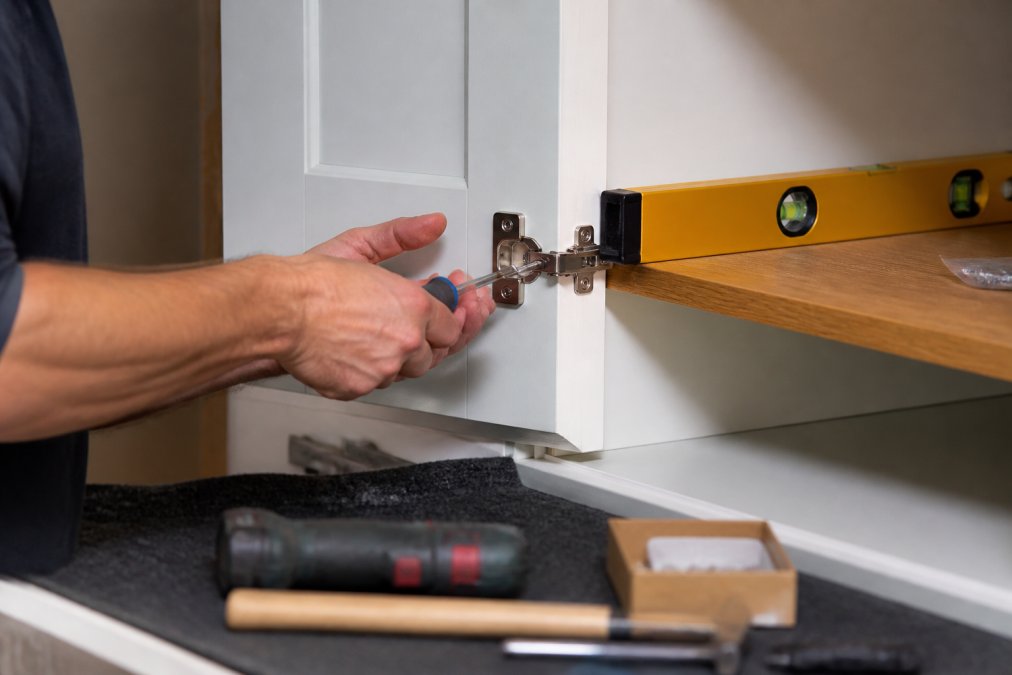
Work in this sequence:
- Door sits too high or low: adjust the vertical screw on the plate.
- Door gap uneven along the edge: adjust the side-to-side screw on the arm.
- Door stands proud or sits too deep: adjust the depth screw, which moves the door toward or away from the carcass.
- Door drops over time: check screw tightness first, then consider whether the hinge is under-rated for the door weight.
Common Mistakes When Choosing Cabinet Hinges
The expensive mistakes are almost always measurement errors made before ordering, not fitting errors made after.
- Measuring overlay on the wrong side of the door.
- Assuming every door takes a 35 mm bore without checking.
- Ignoring door weight until the door sags three months later.
- Buying arms and plates from different ranges and finding they do not seat.
- Skipping a test fit on one door before ordering for the whole kitchen.
Frequently Asked Questions
What is the difference between full overlay and inset cabinet hinges?
Full overlay hinges sit on the door face and cover the cabinet carcass almost completely, so the door hides the frame when closed. Inset hinges sit inside the cabinet opening, with the door flush against the frame. Inset doors need a cranked hinge arm and more precise boring because there is no overlap to hide errors. Full overlay is the standard for modern kitchens, while inset suits traditional and bespoke joinery where the flush finish matters.
How do I measure for replacement cabinet hinges?
Measure the bore diameter first, usually 35 mm on European-style hinges, then check the bore centre distance from the door edge, commonly 3 mm to 6 mm. Note the overlay by measuring how far the door covers the carcass. Finally, match the mounting plate height and screw fixing centres to your existing plate. If any of these differ, the replacement hinge will not sit correctly, even if the bore size matches.
Are Blum and Häfele hinges compatible with all cabinet doors?
No. Both brands make hinges for standard 35 mm bored doors, but compatibility depends on door thickness, overlay, and whether the cabinet is framed or frameless. Thick solid timber doors, for example, need a hinge rated for the weight and a plate that suits the carcass. Always check the hinge's stated door thickness range and overlay before ordering, rather than assuming the brand alone guarantees a fit.
Can I replace old cabinet hinges with modern soft-close versions?
Yes, in most cases. If your doors use a standard 35 mm bore with a 3 mm to 6 mm edge distance, a modern soft-close hinge will usually drop straight in. You may need to swap the mounting plate too, since plate heights vary between systems. Check the screw hole positions on the old plate against the new one before committing, as a mismatch means drilling new holes in the carcass.
Getting the overlay, bore and weight right takes ten minutes of measuring and saves a week of rework. FixFit supplies the hinges, plates, arms and templates to match, backed by a team that will help you confirm the specification before you commit. Browse the range, use the drilling and angle templates to keep positions accurate, and get the right fitting first time. Subscribe to our emails for stock updates and fitting guidance.