

Kitchen Cupboard Door Handles: A 2026 Guide
Table of Contents
- Kitchen Cupboard Door Handles: Choosing the Right Fit
- Handle Styles and Materials That Work
- Best Kitchen Cupboard Handle Finishes
- How to Measure Kitchen Cupboard Handle Centres
- Installing Kitchen Cupboard Handles Without Damaging Doors
- Pricing and Value Across Handle Types
- Frequently Asked Questions
Last Updated: September 25, 2026
Kitchen Cupboard Door Handles: Choosing the Right Fit
Kitchen cupboard door handles are one of those details that can transform a space without anyone quite noticing they've changed. Get them right, and your kitchen feels cohesive and functional. Get them wrong, and every time you reach for a door, something feels off.
The challenge is that most people approach this backwards. They pick a style they like, order it, and hope it works. Then the handles arrive and either they're too small for the space, too large for the drawer, or they don't quite match the aesthetic they were imagining. At FixFit, we help joiners, cabinet makers, and homeowners navigate this exact problem. The real difference between a successful installation and a frustrating one comes down to three things: understanding your options, measuring correctly, and knowing how to install without damage.
This guide walks you through everything you need to know about kitchen cupboard door handles. We'll cover the styles and materials that actually work, how to measure properly, installation techniques that protect your doors, and where to find quality handles at sensible prices. By the end, you'll have the knowledge to make a confident choice that lasts.
Handle Styles and Materials That Work
Kitchen cupboard door handles come in far fewer genuine categories than marketing would have you believe. Strip away the branding and you're looking at a handful of core styles, each suited to different kitchens and different hands.
T-bar and knurled handles dominate modern kitchens for good reason. They're straightforward to grip, they work with almost any aesthetic from contemporary to transitional, and they age well. The knurled design (that cross-hatch texture) serves a practical purpose beyond looks, it improves grip without requiring a tight squeeze. Our Cabinet Knurled Pull Handle in Antique Brass costs £2.85 and delivers exactly this. The solid aluminium construction means it won't strip or corrode, and the 20 mm protrusion gives enough clearance.

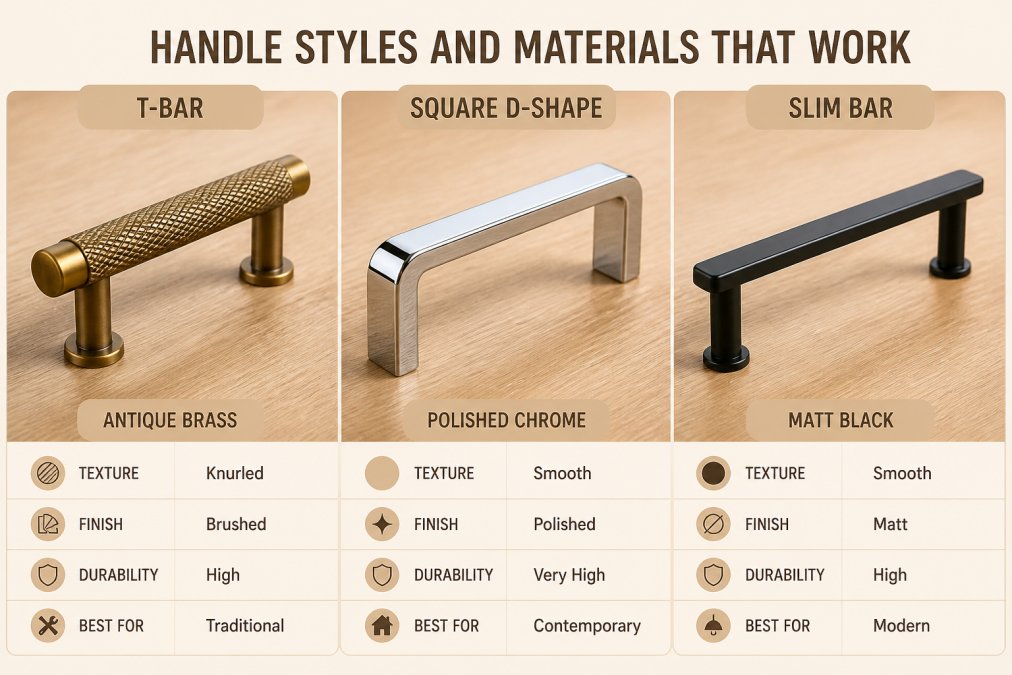
Cup and D-shaped handles work best in kitchens with a more minimal aesthetic. These slim profiles sit flush against the door, which appeals to designers chasing clean lines. They're less forgiving ergonomically, your hand has less to work with, but for lightweight drawers and cabinet doors, they're perfectly adequate. The trade-off is real though. A D-shaped handle requires more deliberate grip than a T-bar. If your household includes children or anyone with reduced hand strength, this matters. Our Cabinet Pull Handle in Polished Chrome Square Shape at £2.34 is typical of this category. At just 9 mm wide and 28 mm tall, it's subtle. The zinc alloy construction is durable for residential use.

Material choice divides into three practical camps: aluminium, zinc alloy, and stainless steel. Aluminium handles (like our knurled T-bars) resist corrosion naturally and feel substantial in the hand. Zinc alloy is lighter and cheaper, which is why it appears in budget ranges, but it's perfectly serviceable for domestic kitchens away from steam and moisture. Stainless steel is the premium option, it's nearly indestructible but significantly more expensive and can feel cold and industrial in traditional kitchens.
Finish matters as much as material. Antique brass develops character over time and hides fingerprints. Polished chrome reflects light and reads as contemporary but shows every smudge. Matt black is forgiving and pairs with almost anything, though it can look dated in five years if the trend shifts. Our Cabinet Pull Handle in Matt Black at £2.37 represents the middle ground, durable, versatile, and priced for real kitchens.

Best Kitchen Cupboard Handle Finishes
The finish you choose affects three things: how the kitchen looks, how easy the handles are to maintain, and how well they'll age.
Antique brass is a finish that can develop a patina over time, adding depth to your kitchen. The downside is that it may require occasional cleaning to prevent buildup, and it won't suit every kitchen aesthetic. It works well in transitional and traditional spaces.
Polished chrome is bright, reflective, and can appear contemporary. It may show fingerprints, which means you might wipe it down regularly if you want it to look pristine. Polished chrome can work well in kitchens with stainless steel appliances and modern cabinetry.
Matt black can hide fingerprints, pairs with almost any colour scheme, and requires minimal maintenance. Matt black is versatile enough to work across contemporary, industrial, and even transitional spaces.
Satin finishes sit between polished chrome and matt black, they catch light subtly. They are often more expensive than both.
The practical approach: choose the finish that matches your appliances and cabinet doors first, then verify it suits your maintenance tolerance.
How to Measure Kitchen Cupboard Handle Centres
Measuring kitchen cupboard handle centres correctly is the difference between an installation that works and one that requires drilling new holes. Most mistakes happen here, so it's worth understanding the measurement system.
Cabinet Knurled Pull Handle ANTIQUE →
The "centre" measurement, abbreviated CC and measured in millimetres, is the distance between the two screw holes that hold the handle in place. This is the only measurement that matters for ordering. A handle marked "128 mm CC" has its screw holes 128 mm apart. That's it. Everything else (overall length, protrusion, height) follows from that.
To measure your existing handles, measure from the centre of one screw hole to the centre of the other. Use a steel ruler or tape measure, not a fabric one. Write the number down. When you order replacements, match that number exactly. Standard kitchen handles come in 96 mm, 128 mm, 160 mm, 192 mm, 256 mm, and 320 mm CC sizes. Most domestic kitchens use 128 mm or 160 mm for drawers and 192 mm or 256 mm for cabinet doors, but this varies.
If you're fitting handles to new cabinetry, the decision is yours. Smaller handles (96-128 mm) suit narrow drawers and create a delicate aesthetic. Larger handles (256-320 mm) work on wide cabinet doors and feel more substantial. A practical rule: measure the width of your door or drawer, then choose a handle size that leaves at least 30-40 mm clearance on each side of the handle. This prevents your knuckles catching the cabinet frame when you pull.
The overall length of the handle, the distance from the outermost edge of one end to the outermost edge of the other, is separate from CC. Our Cabinet Knurled Pull Handle in Gold with 128 mm CC has an overall length of 182 mm. This matters because it determines how far the handle protrudes from the door face. Measure your space, particularly in tight kitchens.
Write down three measurements before you order: the CC distance, the width of your door or drawer, and the clearance available on either side of where the handle will sit. This takes five minutes and prevents costly mistakes.
Installing Kitchen Cupboard Handles Without Damaging Doors
Installing kitchen cupboard handles without damaging doors requires three things: the right tools, the right technique, and patience.
Start with the tools. You'll need a cordless drill with a small drill bit (usually 3 mm for M4 screws), a spirit level, a ruler or measuring tape, a pencil, and the screws that come with your handles. If the screw holes don't already exist, you'll need to drill them. If they do exist and you're replacing handles, you might be able to reuse the holes if the CC measurement matches. Don't assume, measure first.
The technique for drilling new holes is straightforward but easy to mess up. Mark the centre point of where each hole will go using your measurements. Use a pencil, not a pen. Double-check your measurements before drilling. A small pilot hole (2 mm) first, then enlarge to 3 mm, prevents the drill bit from skidding and splitting the door. Drill slowly and let the bit do the work, forcing it damages both the bit and the door veneer.
When inserting screws, hand-tighten first. This lets you verify alignment before the screw is fully seated. If it's going in crooked, stop, back it out, and start again. Once hand-tight, use the drill on low speed to finish tightening. Over-tightening strips the hole and can crack the door if it's veneered. You want snug, not crushed.
For existing holes that don't quite match your new handle's CC measurement, the temptation is to force it. Don't. Drilling new holes is a five-minute job. Forcing a mismatched handle strips holes and weakens the door.
Pricing and Value Across Handle Types
Kitchen cupboard handle pricing reflects material, finish, and brand positioning more than actual quality differences.
| Handle Type | Material | Typical Price | Best For | Maintenance |
|---|---|---|---|---|
| T-bar knurled | Solid aluminium | £2.85-£3.85 | Modern kitchens, high traffic | Occasional cleaning |
| D-shaped slim | Zinc alloy | £2.34-£2.50 | Minimalist spaces, light use | Regular cleaning (fingerprints) |
| Cup handles | Zinc alloy | £1.80-£2.40 | Budget projects, traditional kitchens | Minimal |
| Premium stainless | Stainless steel | £8-£15+ | Commercial, high-end residential | Minimal |
Frequently Asked Questions
How do I choose the right size for kitchen cupboard handles?
Handle size depends on your door width and personal preference. The key measurement is the centre-to-centre (CC) distance between screw holes. For standard kitchen cupboards, 96 mm to 192 mm CC handles work well on smaller doors, whilst 256 mm to 320 mm suits larger cabinet fronts. Measure your existing holes or the space available before ordering. Handles typically protrude 20 mm from the surface, so ensure this suits your kitchen layout.
What's the difference between T-bar and cup handles for kitchen cupboards?
T-bar handles offer a modern, linear appearance with a comfortable grip across a wider surface. Cup handles sit flush and are ideal for minimalist designs. T-bar handles suit contemporary kitchens and provide better ergonomics for frequent opening, whilst cup handles work in traditional or compact spaces. Choose based on your kitchen style and how often doors are opened daily.
Which kitchen cupboard handle finishes are most durable?
Antique brass develops patina over time but remains durable with occasional cleaning. Regular gentle cleaning with a soft cloth keeps any finish looking new for years.
Can I install new kitchen cupboard handles myself without professional help?
Yes, most handles install in minutes with basic tools. You'll need a drill, screwdriver, and measuring tape. Pre-drill pilot holes to prevent splitting wooden doors, use the M4 screws provided, and ensure handles are level before tightening fully. Protect the door surface with tape during drilling. If doors are veneered or very delicate, consider professional installation to avoid damage.