

What Type of Hinges Are Best for Cabinets?
Table of Contents
- Choosing the Right Cabinet Hinges: A Quick Comparison
- Overlay Cabinet Hinges: Full, Half and Inset Explained
- The Best Soft-Close Cabinet Hinges for Different Doors
- How to Measure Cabinet Hinges Before You Order
- Cabinet Hinge Replacement: Matching Old Hinges to New
- Face Frame or Frameless: Matching Hinges to Cabinet Construction
- Conclusion
- Frequently Asked Questions
Last Updated: October 18, 2026
Choosing the Right Cabinet Hinges: A Quick Comparison
Most cabinet doors fail at the hinge, not the door. Pick the wrong type and you get doors that rub, sag, or slam, no matter how well the carcass was built. At FixFit, we supply hinges to joinery workshops and fit-out teams every week, and the question we hear most often is simple: what type of hinges are best for cabinets? The honest answer is that "best" depends on three things: your overlay, your cabinet construction, and the weight of the door.
Here is the short version before we go deeper. Concealed European-style hinges suit the vast majority of kitchen and furniture doors. Full overlay hinges are the default for modern frameless cabinets. Face-fix compact hinges are the practical choice for traditional face frame construction. Wide-angle hinges solve the corner-cabinet and pull-out problem.

| Hinge Type | Best For | Typical Overlay | Door Weight | Opening Angle |
|---|---|---|---|---|
| Full overlay concealed | Frameless and face frame cabinets, standard doors | Covers most of the carcass edge | Light to medium | 110° |
| Half overlay concealed | Two doors meeting on a shared divider | Half the carcass edge | Light to medium | 110° |
| Inset concealed | Doors sitting flush inside the carcass | Flush, no overlap | Light to medium | 110° |
| Face-fix compact | Traditional face frame cabinets | 25-39mm | Light to medium | 107-110° |
| Wide angle | Corner cabinets, internal pull-outs | Full overlay | Light to medium | 165° |
| Heavy duty sprung | Thick, heavy, glass or metal doors | Full overlay | Up to 25kg on two hinges | 95° |
That table covers the decision in one glance. The rest of this guide explains why each row sits where it does, so you can match the hinge to the job rather than guessing from a catalogue photo.
Overlay Cabinet Hinges: Full, Half and Inset Explained
Overlay cabinet hinges are classified by how much of the cabinet carcass the door covers when closed. Get this wrong and the door either fouls its neighbour or leaves an ugly gap.
Full overlay means the door covers almost the entire carcass edge, leaving only a small reveal. This is the standard for modern kitchens where doors sit close together with a clean, continuous front. A Blum 71B3590 INSERTA Soft Close 110° Full Overlay Cabinet Hinge at £4.28 handles doors up to 24mm thick and gives you three-dimensional adjustment: ±2mm side, and +3/-2mm depth via a spiral screw.
Half overlay (also called dual overlay) is used where two doors meet in the middle of a shared carcass divider. Each door covers half the divider. The Blum 71B3690 Half Overlay hinge at £4.62 is the direct equivalent, same 110° opening and same INSERTA tool-free assembly.

Inset doors sit flush within the carcass opening, so the door face is level with the frame. This is the hardest overlay to get right because there is no margin for error. The Blum 71B3790 Inset hinge at £4.36 is built specifically for this application.
The Best Soft-Close Cabinet Hinges for Different Doors
Soft-close is not one feature; it is a mechanism that has to suit the door it carries. A soft-close hinge tuned for a heavy oak door will feel sluggish on a light melamine front, and vice versa.
For standard kitchen doors, integrated Blumotion is the benchmark. The Blum ClipTop range builds the damping directly into the hinge boss, so there is nothing extra to fit. On small or light doors, you can deactivate the Blumotion function on one of the two hinges by sliding a switch on the hinge boss, then closing the door once. That single detail solves the most common soft-close complaint: doors that will not close fully because the damper is fighting a light front.
For wide-opening applications, the GTV Soft Close 165° Full Overlay Wide Angle Cabinet Hinge (box of 50, £117.00) opens far enough for internal pull-outs to clear the door. The zero-protrusion design means drawers pull forward past the door without catching. That makes it the right pick for corner cabinets and larder units with internal storage.

Heavy doors need a different answer entirely. The Sugatsune Sprung Full Overlay Heavy Duty Cabinet Hinge J95-C24/25T at £11.79 carries up to 25kg on two hinges or 40kg on three, suits door thickness up to 34mm, and works with wood, glass or metal fronts.
How to Measure Cabinet Hinges Before You Order
Measuring a cabinet hinge takes about five minutes per door and prevents the most expensive mistake in the whole process: ordering hinges that do not fit the bore you already have.
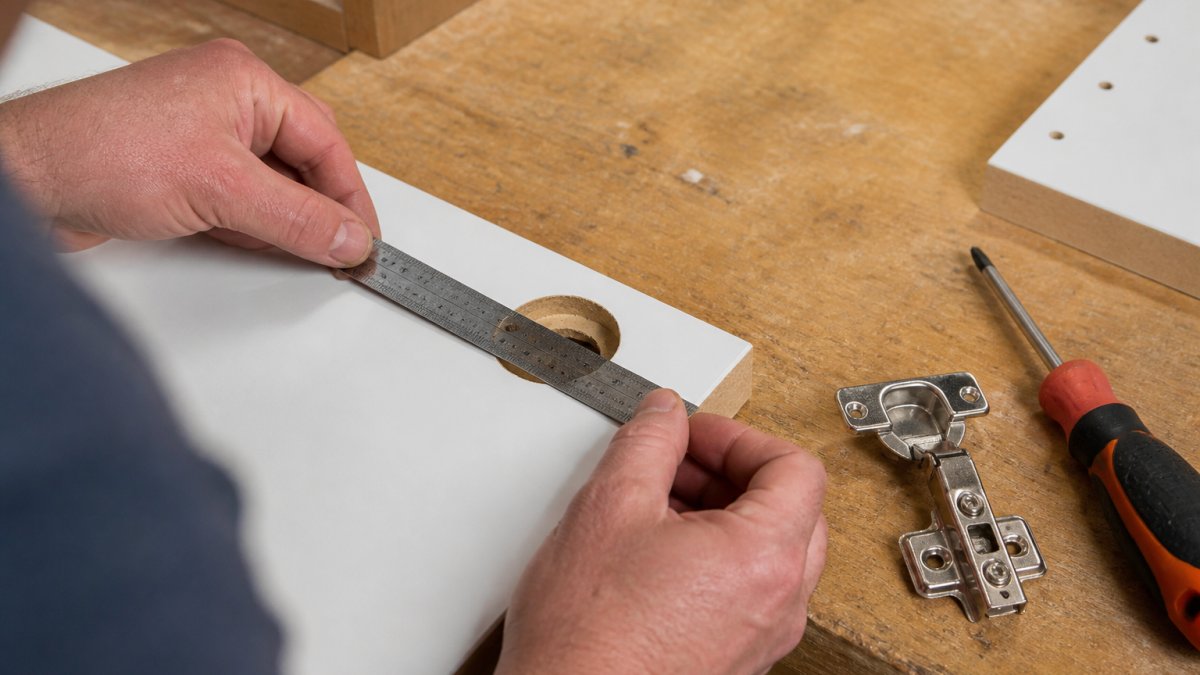
Work through these measurements in order:
- Cup diameter. Most European concealed hinges use a 35mm cup. The Sugatsune heavy duty hinge uses a 40mm cup, so check before assuming.
- Cup depth. Measure how deep the bore goes into the door. A 13mm cup depth is common on compact face-fix hinges.
- Door thickness. Standard concealed hinges suit doors up to 24mm. The Blum 38B355AF22 Sprung Compact Face Fix Hinge covers 16-24mm; the Sugatsune covers up to 34mm.
- Overlay. Measure how far the door edge extends past the carcass side. This tells you whether you need full, half or inset.
- Hinge hole centres. On a replacement job, measure the distance between the existing screw holes so the new hinge plate lines up without re-drilling.
Write the numbers down per door, not per kitchen. Doors on the same run can vary, particularly on older cabinetry that has been adjusted over the years.
Cabinet Hinge Replacement: Matching Old Hinges to New
Cabinet hinge replacement is where most DIY projects stall. The old hinge is discontinued, the screw holes do not match, and the door will not hang straight on a modern equivalent.
Blum 71B3590 INSERTA Soft Close 110° Full Overlay Cabinet Hinge →
The practical route is to match by specification rather than by brand. Note the cup diameter, cup depth, overlay, opening angle and mounting plate type. A 35mm cup, 110° opening, full overlay hinge is a standard specification, and most quality ranges will have a match.
Where the screw holes do not align, the answer is usually a mounting plate with slotted fixings rather than drilling new holes in a sound door. On face frame cabinets, a face-fix compact hinge such as the Blum 38B355AF22 at £3.98 screws directly to the frame face and avoids the need to bore a new cup position.
Face Frame or Frameless: Matching Hinges to Cabinet Construction
Cabinet construction decides which hinge family you can use, and this is the step most buyers skip.
Frameless cabinets (also called European or full-access carcasses) have no face frame, so the door mounts directly to the carcass side. Concealed cup hinges are the natural fit, and full overlay is the usual choice. The Blum INSERTA range is designed for this: tool-free hinge-to-door assembly means you press the hinge into the bored cup rather than screwing it.
Face frame cabinets have a solid timber frame around the opening. Here you have two options. You can use a concealed hinge with a mounting plate that fixes to the frame, or you can use a one-piece compact hinge that wraps around the frame face. The Blum Blumotion Compact Overlay Face Fix 110° at £5.84 is a one-piece design with the soft-close built into the cup, available in 25mm, 31mm, 35mm and 39mm overlays.
Glass doors need their own solution. The Hafele Glass Door Pivot Hinges 110° at £1.58 per set of two suit inset glass doors up to 5mm thick, with a maximum door width of 400mm and height of 600mm.
For joinery workshops running multiple projects, keeping a consistent hinge family across jobs pays off in adjustment familiarity and spare plate compatibility. That is the reasoning behind our curated range at FixFit: Blum, Hafele, GTV, Sugatsune and Tutti, stocked so the right hinge arrives first time around rather than three weeks after the door is hung.
Conclusion
The hinge decision comes down to overlay, construction and door weight, and getting those three right removes almost every fitting problem before it starts. Order the wrong cup size or overlay and no amount of adjustment will save the door.
FixFit supplies Blum, Hafele, GTV, Sugatsune and Tutti hinges with trade and DIY customers ordering from the same catalogue. Our team can help you match a specification if you are unsure which hinge suits your carcass, and our stock is held so your project does not stall waiting on a fitting. Subscribe to our emails for restock alerts and new product lines.
Frequently Asked Questions
What type of hinge is best for kitchen cabinets?
Concealed cup hinges are the standard choice for kitchen cabinets because they hide the mechanism inside the door and carcass. For a full overlay door, the Blum 71B3590 INSERTA Soft Close 110° hinge at £4.28 gives tool-free door fitting and three-dimensional adjustment. If your doors are inset, the Blum 71B3790 at £4.36 is the matching option. Both are steel, nickel-plated and suit doors up to 24mm thick, which covers most kitchen door stock.
Are soft-close hinges worth it for cabinets?
Soft-close hinges add roughly £1 to £2 per hinge over standard sprung hinges, and most cabinet doors need two. The mechanism slows the door in the last few centimetres so it closes quietly without slamming. On the Blum ClipTop range the soft-close action can be switched off on one hinge for small or light doors, so you keep control over how the door behaves. For kitchens and bathrooms used daily, the extra cost is small against the reduction in wear on doors and carcasses.
What is the difference between overlay and inset cabinet hinges?
Overlay hinges sit on the face of the carcass so the door covers the cabinet edge. Full overlay covers the whole frame, half overlay covers part of it where two doors meet, and inset hinges let the door sit flush inside the opening. The hinge you need depends entirely on how the door sits. A full overlay door will not work with an inset hinge, and the reverse is also true, so check the door position before ordering.
How do I know what size cabinet hinge I need?
Measure the bore hole in the door, which is normally 35mm on European-style concealed hinges, and the door thickness, which should fall between 16mm and 24mm for most Blum ClipTop hinges. Also measure the overlay, meaning how far the door covers the carcass edge. The Sugatsune J95-C24/25T uses a larger 40mm cup and handles doors up to 34mm thick, so heavier or thicker doors need a different hinge from the standard 35mm pattern.
Can I replace cabinet hinges without drilling new holes?
Often yes, provided the replacement hinge uses the same cup size and mounting plate screw pattern. A 35mm cup hinge such as the Blum 71B3590 will usually drop into an existing 35mm bore, and the mounting plate screws line up if the plate footprint matches. Take the old hinge with you or measure the cup diameter, the plate hole spacing and the overlay before ordering. If the pattern differs, you may need to fill and re-drill the plate screw holes.
How many hinges does a cabinet door need?
Most standard cabinet doors up to around 900mm tall use two hinges. Taller doors, or doors carrying more weight, need a third. The Sugatsune J95-C24/25T is rated at 25kg across two hinges and 40kg across three, so weight is the deciding factor rather than height alone. For a heavy solid timber or glass door, work out the door weight and divide it by the hinge rating before deciding on two or three.