

Full Extension vs Partial Extension Slides
Table of Contents
- Full Extension vs Partial Extension Slides: Key Differences
- How to Measure Drawer Slides for Your Project
- Drawer Slide Weight Capacity: What You Need to Know
- Undermount vs Side Mount Drawer Slides
- Cost Comparison and Value
- Which Type Should You Choose?
- Frequently Asked Questions
Last Updated: September 23, 2026
Full Extension vs Partial Extension Slides: Key Differences
Full extension vs partial extension slides represent the fundamental choice when selecting drawer runners for cabinetry projects. At FixFit, we help joiners, cabinet makers, and DIY enthusiasts understand these critical differences so you can specify the right hardware first time around.

The core distinction is straightforward: full extension slides allow the drawer to extend completely, typically 95-100% of the runner length, whilst partial extension slides stop short, usually at 50-75% extension. This difference affects usability, cost, installation complexity, and project suitability.
Understanding which type suits your project prevents costly mistakes. A kitchen renovation requiring full access to deep drawers demands different runners than a filing cabinet where partial extension suffices. Below, we'll show you exactly how to measure, compare weight capacities, and select between mounting styles so you specify the correct runners for every application.
How to Measure Drawer Slides for Your Project
Measuring drawer slides accurately determines whether your runners will fit and function properly. The measurement process involves three key dimensions: internal drawer width, drawer depth, and side thickness.
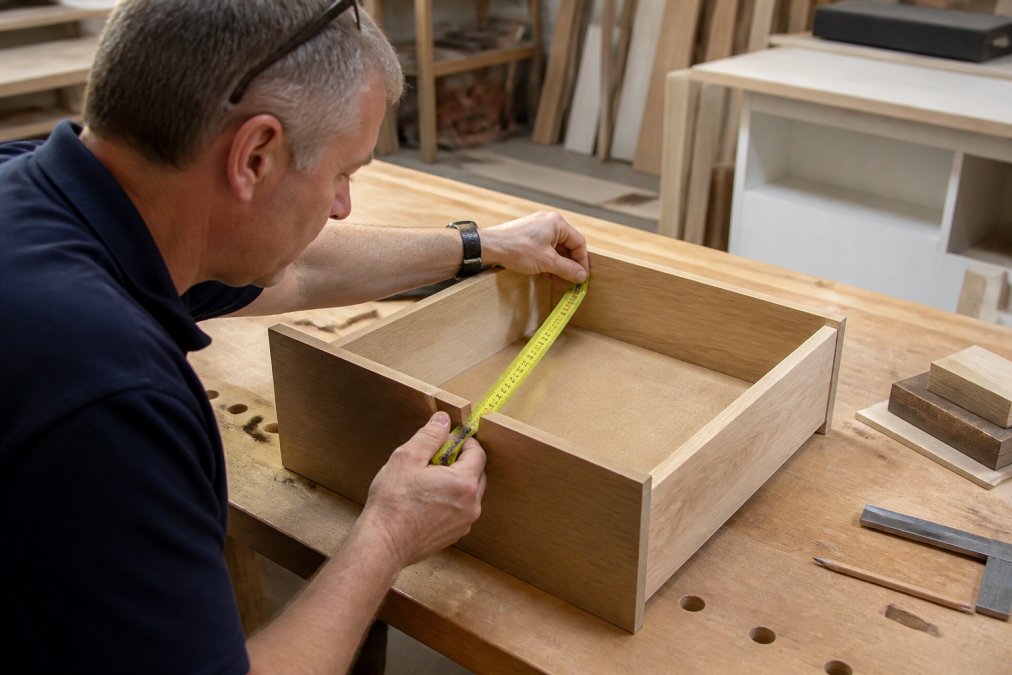
Start by measuring the internal width of your drawer opening. Measure from the inside of one side panel to the inside of the opposite side panel. This width determines the maximum runner length you can accommodate. Runners must be shorter than your drawer width to allow clearance on both sides, typically allow 10-15mm total clearance.
Next, measure the drawer depth from the inside front to the inside back. This measurement is critical for full extension vs partial extension slides because it determines whether the drawer can physically accommodate the extended runner. Full extension runners require more internal depth than partial extension alternatives.

Finally, measure the thickness of your drawer side panels. Most wooden drawer sides range from 11-16mm thick. This thickness affects mounting options and runner selection. The British Standards Institution guidance on cabinet construction recommends verifying side thickness before ordering runners, as incorrect thickness can compromise load capacity.
Common mistakes include measuring the external drawer dimensions rather than internal ones, and failing to account for the runner's own thickness when calculating clearance. Always measure twice and verify that your selected runners are available in sizes matching your drawer depth.
Drawer Slide Weight Capacity: What You Need to Know
Weight capacity determines whether your selected runners will safely support the drawer contents over its lifespan. Every runner has a rated load capacity, typically ranging from 25kg to 45kg depending on the runner type and construction quality.
Full extension runners often carry higher weight capacity ratings than partial extension alternatives because they distribute load across a longer travel distance and typically use ball bearing construction. For example, the Blum engineering specifications show that their full extension Tandem runners handle 30kg loads reliably, whilst partial extension designs may rate lower.
The weight capacity you need depends on the drawer's intended use. A kitchen utensil drawer needs minimal capacity, perhaps 10-15kg total. A workshop tool drawer or heavy-duty filing cabinet demands 35-45kg capacity. Calculate your likely maximum load by considering what you'll actually store, then select runners rated 20-30% above that figure as a safety margin.
Ball bearing construction typically offers higher weight capacity than slide-based systems. The GTV Standard Full Extension Ball Bearing runners at FixFit carry 35kg capacity, making them suitable for demanding applications. Soft-close systems add friction during the closing cycle, which can reduce effective load capacity slightly, though quality units like the Blum Blumotion system maintain full rated capacity throughout the closing motion.
Installation quality affects real-world performance as much as rated capacity. Runners mounted to weak backing or misaligned panels will fail prematurely regardless of their rated capacity. Always ensure solid timber support behind mounting points.
Undermount vs Side Mount Drawer Slides
Mounting style determines how visible the runners are and affects installation complexity and cost. Undermount runners sit beneath the drawer, hidden from view, whilst side mount runners attach to the drawer sides and remain visible.
Undermount runners deliver a premium aesthetic because they're completely concealed. They suit high-end kitchens and bespoke furniture where appearance matters. The Blum TANDEM Full Extension Blumotion runners at FixFit mount undermount-style, providing that invisible hardware look. Undermount installation requires precise measurement and alignment because the runners sit underneath where adjustment is difficult once installed.

Side mount runners attach to the outer faces of your drawer sides, making them visible when the drawer is open. They're simpler to install because you can see exactly what you're doing and adjust alignment more easily. The GTV Standard Full Extension Ball Bearing runners mount side-style and cost considerably less than undermount alternatives. For utilitarian applications, workshops, storage areas, utility rooms, side mount runners make practical sense.
Blum TANDEM Full Extension Blumotion 30 →
Cost difference between mounting styles is significant. Side mount runners like the GTV option at £3.10 per pair represent budget-friendly choices. Undermount runners from quality manufacturers cost 3-8 times more because they require precision engineering and more complex manufacturing. The Blum Blumotion undermount system costs £26.57, reflecting the engineering complexity and soft-close integration.
Installation time differs markedly too. Side mount runners typically take 15-20 minutes per drawer because you simply screw them to the sides. Undermount runners demand 30-45 minutes because they require careful measurement, drilling precise holes in the drawer base, and ensuring perfect alignment before fixing.
Choose undermount when appearance is the priority and budget allows. Select side mount when cost, ease of installation, and visibility of the runner mechanism don't matter for your project type.
Cost Comparison and Value
Drawer slide costs vary dramatically based on type, mounting style, and quality. Understanding the price-to-value relationship prevents overspending on features you don't need whilst avoiding false economy on critical projects.
Basic side mount full extension runners start at £3.10 per pair for the GTV Standard option at FixFit. These deliver genuine full extension and 35kg capacity at minimal cost, making them ideal for workshops, storage, and utilitarian applications where aesthetics don't matter.
Mid-range options like the GTV Push to Open Full Extension Undermounting at £9.92 add convenience features, push-to-open mechanism and undermount concealment, without premium pricing. This represents good value for DIY kitchen renovations where you want hidden hardware but don't need soft-close luxury.
Premium soft-close undermount runners command significantly higher prices. The Soft Closing Ball Bearing Drawer Runners Black Standard Full Extension cost £27.78, and the Blum TANDEM Full Extension Blumotion costs £26.57. These prices reflect integrated soft-close mechanisms, precision ball bearing construction, and engineering for high-end cabinetry.
Partial extension runners like the Blum TANDEM Single Extension Blumotion cost £14.24, roughly half the price of the full extension equivalent. This price difference reflects simpler construction and shorter runner length. For applications where full access isn't essential, filing cabinets, shallow storage, partial extension runners deliver savings without sacrificing functionality.
Value isn't determined by price alone. A £3.10 runner that fails after two years costs more than a £27 runner lasting fifteen years. Consider the project lifespan, usage intensity, and importance of reliability. Professional kitchens and high-use commercial applications justify premium runners.
Which Type Should You Choose?
Selecting between full extension vs partial extension slides depends on three factors: intended use, available space, and budget constraints.
| Runner Type | Mounting | Extension | Load Capacity | Price | Best For |
|---|---|---|---|---|---|
| Blum TANDEM Full Extension Blumotion | Undermount | 95-100% | 30kg | £26.57 | Premium kitchens, soft-close requirement |
| Blum TANDEM Single Extension Blumotion | Undermount | 50-75% | 30kg | £14.24 | Partial access, budget-conscious premium |
| GTV Standard Full Extension Ball Bearing | Side Mount | 95-100% | 35kg | £3.10 | Workshops, storage, utilitarian use |
| Accuride Soft Closing Ball Bearing | Side Mount | 95-100% | 45kg | £27.78 | High-traffic kitchens, soft-close essential |
| GTV Push to Open Full Extension | Undermount | 95-100% | 25kg | £9.92 | DIY kitchens, convenient access |
Frequently Asked Questions
What is the main difference between full and partial extension drawer slides?
Full extension slides allow the drawer to open completely, with the drawer box extending fully beyond the cabinet body. Partial extension slides (typically 3/4 extension) stop short, leaving part of the drawer inside the cabinet. Full extension gives complete access to the entire drawer depth and contents, whilst partial extension saves space and costs less.
How do I measure drawer slides correctly for replacement?
Measure the distance from the back of the cabinet opening to the front edge where the drawer front sits. This is your slide length. Also measure the thickness of your wooden drawer sides (typically 11-16 mm for standard cabinetry). Check whether your current slides mount underneath (undermount) or on the side. Record these three measurements before ordering replacements to ensure proper fit.
What drawer slide weight capacity do I need for my project?
Calculate the weight of your fully loaded drawer, then choose slides rated above that. Standard kitchen drawers typically hold 20-35 kg. The Blum TANDEM Full Extension Blumotion slides handle 30 kg, whilst side-mounted ball bearing options support up to 45 kg. Always select slides with a capacity at least 25% higher than your expected load to ensure long-term durability.
Are full extension slides more expensive than partial extension slides?
Yes, full extension slides generally cost more because they require stronger mechanisms and more material. Budget-friendly partial extension options start from £3.10, whilst full extension undermount slides like the Blum TANDEM range from £14.24 to £26.57. The investment pays off in convenience and durability for frequently used drawers.
Can I use full extension slides in a kitchen with limited cabinet depth?
Full extension slides require the cabinet interior to be deep enough for the entire drawer box to extend beyond the cabinet face. If your cabinet depth is less than 300 mm, partial extension slides are safer. Measure your cabinet interior depth first. If you have adequate depth (typically 400 mm or more), full extension slides provide superior access without modification.