

Heavy Duty Locking Drawer Slides Review: Top Picks for 2026
Table of Contents
- What to Look for in Heavy Duty Locking Drawer Slides
- Full Extension vs Partial Extension Slides: Which Do You Need?
- How to Measure for Drawer Slides
- Heavy Duty Drawer Slide Installation Guide
- Top Heavy Duty Locking Drawer Slides Reviewed
- Frequently Asked Questions
Last Updated: September 30, 2026
What to Look for in Heavy Duty Locking Drawer Slides
A heavy duty locking drawer slides review starts with two questions most buyers skip: how does the lock actually engage, and how much weight will the runner carry day after day? Get either wrong and you'll be refitting the cabinet within a year. This guide from FixFit covers the locking mechanisms, load ratings and measuring rules that separate a runner that lasts from one that sags.
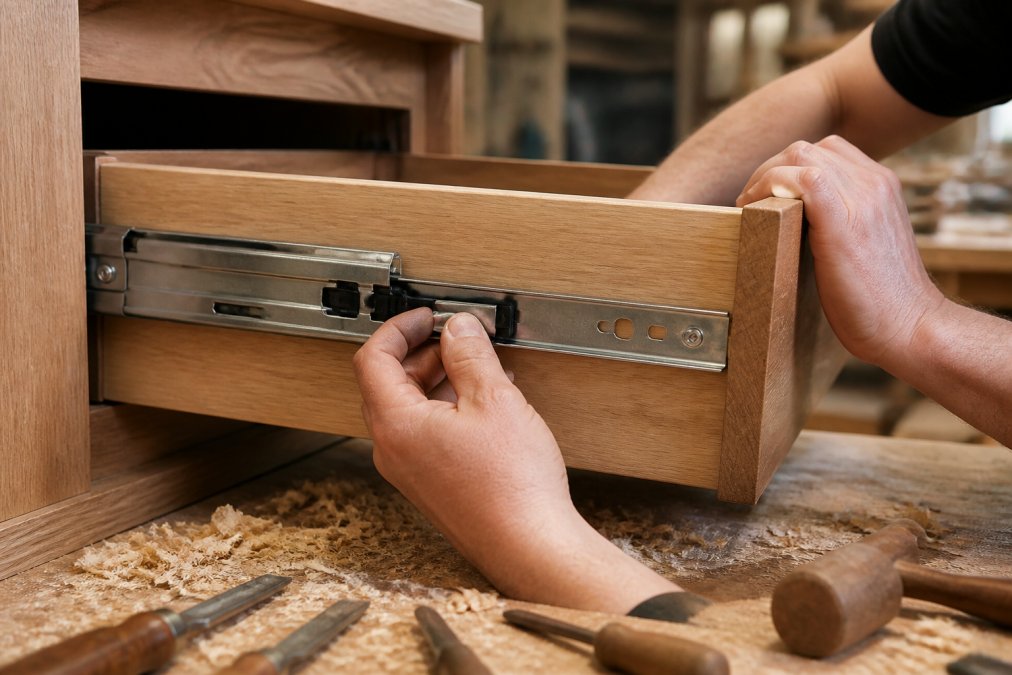
Locking Mechanisms: Lock-In vs Lock-Out
Lock-in slides hold the drawer closed until you release a catch, which stops it sliding open in transit or on a sloped floor. Lock-out slides hold the drawer open at full extension, useful when you're loading a heavy tray and need both hands.
Many heavy duty runners combine both. A lock-in detent keeps the drawer shut; a lock-out catch stops it rolling closed while you work. The trade-off is a firmer pull to release, which some users find stiff on lighter drawers.
Load Capacity and Slide Thickness
Load capacity is the maximum weight a runner pair carries when mounted correctly and evenly loaded. Thickness tells you how it gets there. A 45mm-high, 12.7mm-thick ball bearing runner suits standard drawers, while a 53mm-high, 19.5mm-thick slide handles far heavier loads.
Match the rating to the job, not the other way round:
- Up to 30kg: light duty kitchen and bedroom drawers
- 35-50kg: general cabinet and workshop drawers
- 100kg: heavy tool drawers, filing and industrial units
| Runner Type | Height | Thickness | Load Rating | Best For |
|---|---|---|---|---|
| Standard ball bearing | 45mm | 12.7mm | 30-35kg | Kitchen and bedroom drawers |
| Black full extension | 45mm | 12.7mm | 45-50kg | Pull-out shelves, utensil drawers |
| Heavy duty side mounted | 53mm | 19.5mm | 100kg | Tool drawers, industrial units |
Full Extension vs Partial Extension Slides: Which Do You Need?
Full extension slides let the drawer pull out until the back of it clears the cabinet front, so you can reach every item. Partial extension slides stop short, leaving the rear of the drawer inside the carcass.

For heavy duty locking drawer slides, full extension is usually the right call. A 100kg drawer loaded with tools is hard to reach if the back third stays buried in the cabinet. Full extension also spreads the load across the full length of the runner, which reduces strain on the mounting screws.
Partial extension suits shallow drawers where you rarely need the back, or cabinets with limited clearance behind them. The saving is modest, and the loss of access is permanent.
How to Measure for Drawer Slides
Measuring for drawer slides comes down to three numbers: the drawer length, the cabinet depth and the clearance on each side. Measure the drawer box from front to back, then choose a runner of that length.
A few rules that save a return:
- Never let the drawer width exceed the runner length
- Allow between +0.2mm and +0.5mm over the nominal runner thickness for the runner space
- Check the extension loss on shorter sizes, as some only fully extend from 400mm upward
For side mounted runners, the slide fixes to the side of the drawer box and the inside of the cabinet. Measure the gap on both sides, not just one.
Heavy Duty Drawer Slide Installation Guide
Installation follows the same sequence whether you're fitting a 30kg kitchen runner or a 100kg industrial slide. Fix the cabinet member first, then the drawer member, then align and test before final tightening.
Mounting and Alignment Tips
Work in this order:
- Mark the runner height on both cabinet sides using a spacer to keep them level
- Screw the cabinet member in place, leaving the screws slightly loose
- Fit the drawer member to the drawer box, checking front-to-back alignment
- Set the drawer into the runners and engage the quick release
- Adjust vertical position using the cam adjust where fitted
- Tighten all screws and test the full travel
The quick release system on most side mounted runners lets you lift the drawer out for adjustment without unscrewing anything. Use it. Fighting a loaded drawer back into a misaligned runner is how brackets get bent.
Drawer Runners Heavy Duty Standard Side →
Top Heavy Duty Locking Drawer Slides Reviewed
Two runners cover most heavy duty jobs: a 100kg side mounted slide for maximum load, and a soft close ball bearing runner for smooth daily operation. Both are side mounted, both use ball bearings, and both suit standard or inner drawers.

For Maximum Load: 100kg Side Mounted Runners
The Drawer Runners Heavy Duty Standard Side Mounted 100kg Load is the pick when weight is the deciding factor. It carries up to 100kg per pair, extends fully, and uses a 19.5mm-thick steel body with a zinc plated finish. Sizes run from 300mm to 1100mm, so it suits everything from a deep tool drawer to a wide industrial unit.
It is not soft close, which is the honest trade-off. A 100kg drawer that closes itself is a design problem, not a feature, so the firm close is the right call here. The quick release system makes fitting and removal straightforward.
Pros: 100kg load rating, full extension, wide size range to 1100mm, ball bearing operation Cons: Not soft close, heavier and bulkier than standard runners
For Smooth Operation: Soft Close Ball Bearing Runners
Where the load is lighter but the finish matters, the Drawer Runners Soft Close Side Mounted 45mm Ball Bearing is the better fit. It carries up to 30kg, closes softly over the last stretch of travel, and comes in sizes from 250mm to 700mm. The zinc plated finish suits kitchens, bedrooms and office furniture alike.
The GTV runner is SGS certified for 60,000 cycles, so it stands up to daily use. It is not built for heavy loads, and that is the honest limit: fit it to a standard drawer, not a tool chest.
Pros: Soft close action, SGS certified for 60,000 cycles, quick release system, wide size range Cons: 30kg limit, not suited to heavy or industrial drawers
| Runner | Load Rating | Extension | Soft Close | Best For |
|---|---|---|---|---|
| Heavy Duty 100kg Side Mounted | 100kg | Full | No | Tool drawers, industrial units |
| Soft Close 45mm Ball Bearing | 30kg | Full | Yes | Kitchens, bedrooms, office furniture |
Frequently Asked Questions
What is the difference between lock-in and lock-out drawer slides?
Lock-in slides secure the drawer in the closed position, preventing it from rolling open during transport or on uneven surfaces. Lock-out slides hold the drawer in the fully extended position, which is useful when you need to work inside the drawer without it sliding shut. Some heavy duty locking drawer slides offer both functions. The right choice depends on whether your priority is transit security or access convenience during use.
How much weight can heavy duty locking drawer slides hold?
Load capacity varies by model. In the FixFit range, the 100kg side mounted runners handle up to 100kg per pair, making them suitable for heavy tool drawers and industrial storage. Standard ball bearing runners typically manage 30kg to 50kg. Always check the allowable load stated on the product listing and account for the weight of the drawer box itself, not just its contents, when specifying slides.
How do you install heavy duty locking drawer slides?
Start by measuring the drawer depth and cabinet opening to select the correct slide length. The drawer width must not exceed the slide length for proper operation. Mount the cabinet member first, ensuring it sits level and parallel to the cabinet side. Then attach the drawer member, leaving the recommended clearance (typically 0.2mm to 0.5mm over the nominal runner thickness). Test the locking mechanism engages correctly before loading the drawer.
Are locking drawer slides necessary for vehicle storage?
Locking slides are strongly recommended for vehicle storage. Drawers in vans, trucks and mobile units are subject to vibration and movement that can cause standard slides to roll open. A lock-in mechanism, or a push-to-open slide with a stay-closed feature, keeps drawers secure during transit. For heavier loads, specify slides rated for the actual weight you will carry, plus a safety margin.
What should I check before ordering heavy duty locking drawer slides?
Confirm three measurements: drawer depth (to match slide length), drawer width (which must not exceed slide length), and the total loaded weight of the drawer. Check the slide height and thickness suit your cabinet design. Also verify the locking type you need, whether that is lock-in, lock-out or both. Ordering the correct specification first time avoids returns and project delays.
Choosing between a 100kg industrial runner and a 30kg soft close slide is the decision that makes or breaks a heavy drawer project. Get the load rating and the locking mechanism right, and the cabinet works for years. FixFit supplies both, along with the wider range of GTV, Sugatsune and Tutti runners that cover everything in between, backed by a team that knows joinery fittings rather than a generic warehouse. Order from FixFit and get the right runner, first time.