

7 Ways to Fix Misaligned Cabinet Doors
Table of Contents
- 1. Adjust Cabinet Door Hinges for Perfect Alignment
- 2. Use Cabinet Door Hinge Adjustment Screws Correctly
- 3. Fix a Sagging Cabinet Door with the Right Support
- 4. Replace Worn Hinges to Restore Proper Closure
- 5. Install Repair Plates to Strengthen Hinge Mounting Points
- 6. Straighten Warped Cabinet Doors Before Adjusting
- 7. Check the Cabinet Frame and Carcass for Structural Issues
- Frequently Asked Questions
Last Updated: 5 October 2026
1. Adjust Cabinet Door Hinges for Perfect Alignment
The quickest fix for misaligned cabinet doors starts with the hinges themselves. Most modern hinges offer adjustment on multiple axes, allowing you to correct doors without removing them entirely. This is where many people go wrong: they assume the door is permanently misaligned when a few turns of an Allen key will solve it.
Cabinet hinges typically adjust in three directions: vertical (up and down), horizontal (left and right), and depth (forwards and backwards). The CEAM 3D Cabinet Concealed Adjustable Hinges 929 exemplify this design, offering simple 2.5mm Allen key adjustment on all three axes with removable cover plates that conceal the screws once you're done. This means you can fine-tune alignment without leaving visible adjustment hardware behind.

Start by opening the door fully and observing where it sits relative to the cabinet frame. If it's too high, too low, or tilted, you've identified which axis needs adjustment. Most hinges allow movement of 2-3mm in each direction, which is usually sufficient to bring a slightly misaligned door into perfect alignment.
For doors that open and close smoothly but sit unevenly in the frame, hinge adjustment alone often solves the problem. The Ceam 3D Door Concealed Adjustable Hinges 1129 provide the same three-axis adjustment capability for heavier doors up to 40kg, making it suitable for larger cabinet doors or wardrobe applications where precision matters even more.
2. Use Cabinet Door Hinge Adjustment Screws Correctly
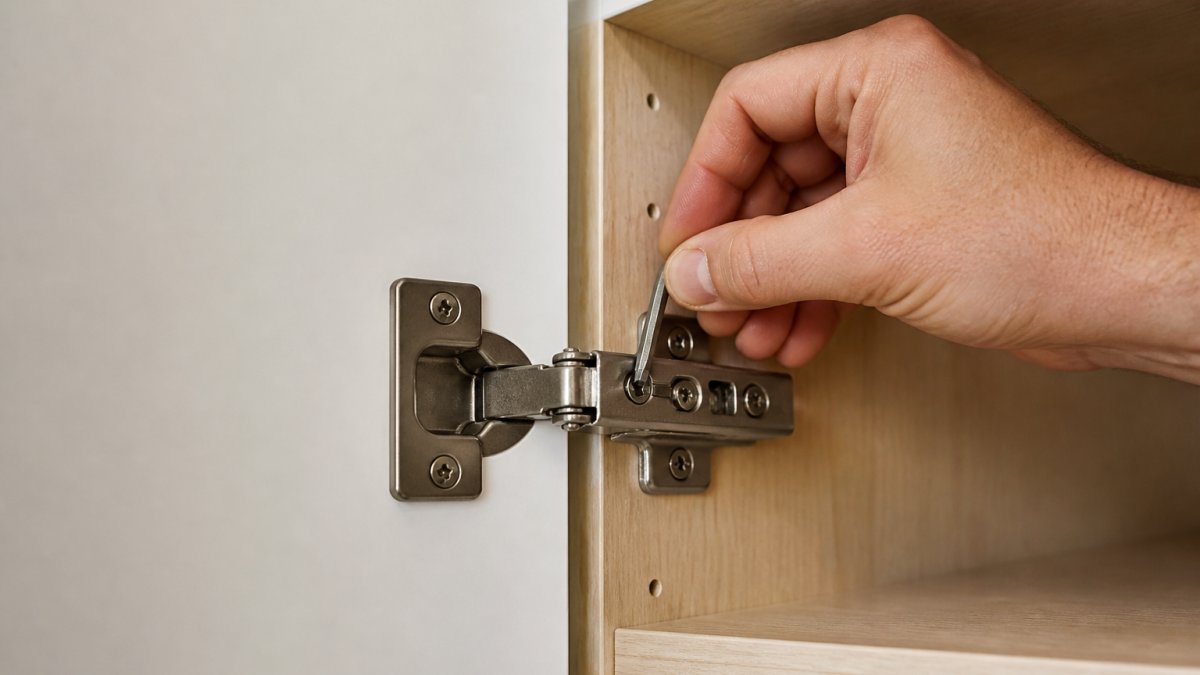
Understanding how adjustment screws work prevents the frustration of endless tweaking. Each screw controls movement in a specific direction, and knowing which one does what saves considerable time. Most hinges include either printed guides on the hinge itself or documentation showing which screw controls which adjustment.
The vertical adjustment screw (often marked or positioned at the top of the hinge) moves the door up and down. The depth screw moves the door forwards or backwards, closing gaps between the door and frame. Blum's compact hinges, such as the Blum 33.3600 Sprung Compact Face Fix Hinge, offer height adjustment of ±3.2mm and depth adjustment of ±2mm, giving you precise control without excessive movement range.

When you turn an adjustment screw, the door moves immediately. This is different from hinge bolts, which require loosening and retightening. Modern concealed hinges use cam technology or threaded posts that allow continuous adjustment. A quarter-turn typically moves the door 0.5-1mm, which is why patience and small movements work better than aggressive adjustments.
Document which screw you adjusted and by how much. If the door goes too far in one direction, you'll know exactly which screw to turn back. This methodical approach beats random adjustments that leave you chasing the problem across multiple axes.
3. Fix a Sagging Cabinet Door with the Right Support
A sagging cabinet door typically hangs lower on one side than the other, creating an uneven gap at the top or bottom. This happens when the hinge mounting points wear, the hinge itself fails, or the cabinet frame shifts slightly.
Start by adjusting the top hinge upwards and the bottom hinge downwards. This compensates for the sag by using the full adjustment range of both hinges. If adjustment alone doesn't solve it, the hinges themselves may be worn or the mounting points damaged.
The Hinge Repair Plate HRPSS provides a stainless steel reinforcement layer that sits behind the hinge mounting point, distributing load across a larger area and compensating for minor damage to the cabinet carcass. For mounting plate side repairs, the Hinge Repair Plate HRPSM offers the same reinforcement.
For heavier doors or those showing consistent sag despite hinge adjustment, consider installing an additional hinge. Many cabinet doors use two hinges, but adding a third hinge in the middle distributes weight more evenly and prevents sagging.
The Door Straightener Recessed For Warped Panel Doors provides an alternative approach for panel doors showing structural sag. This steel straightening system adds rigidity to wooden doors from 16mm thick, preventing warping and sag across the entire door surface. It's particularly useful for large, heavy doors where hinge adjustment alone cannot compensate for structural movement.
4. Replace Worn Hinges to Restore Proper Closure
When hinges reach the end of their lifespan, they no longer hold adjustment, close smoothly, or support the door weight. Worn hinges are the reason many cabinet doors gradually slip out of alignment despite repeated adjustment. Replacement is straightforward and often cheaper than attempting multiple repair approaches.
Identify the hinge type and weight rating before ordering replacements. Cabinet hinges are specified by load capacity, measured in kilograms. A hinge rated for 12kg doors must not be used on 25kg doors, as it will sag under the weight.
The Ceam range offers hinges across multiple weight ratings. The CEAM 3D Cabinet Concealed Adjustable Hinges 929 handle doors up to 21kg when installed with four hinges, whilst the Ceam 3D Door Concealed Adjustable Hinges 1129 supports doors up to 40kg with three hinges.

Removing old hinges requires unscrewing the hinge from the door and cabinet carcass. Concealed hinges are often easier to remove than traditional hinges because the door lifts away from the hinge cup without unbolting anything.
For Blum hinges, ensure you have compatible mounting plates. The Blum Mounting Plate 173L6100 Clip Cruciform 0mm Spacing and Blum Mounting Plate 173H7100 Cruciform 0mm Spacing both offer quick-clip installation, allowing you to swap hinges without removing the mounting plate from the cabinet carcass. This speeds up replacement considerably.
5. Install Repair Plates to Strengthen Hinge Mounting Points
Hinge mounting points deteriorate through repeated use, loose screws, or poor installation. A repair plate reinforces the mounting area and compensates for minor damage without requiring cabinet carcass replacement. This is a cost-effective middle ground between adjustment and hinge replacement.
Repair plates work by distributing the hinge load across a larger area of the cabinet carcass. Instead of the hinge screw bearing down on a single point, the plate spreads that pressure across its entire surface. This prevents the screw from pulling through the wood or enlarging the screw hole.
Ceam 3D Cabinet Concealed Adjustable Hinges 929 →
The Hinge Repair Plate HRPSM is designed for mounting plate side installation, whilst the Hinge Repair Plate HRPSS works on either the hinge or mounting plate side. Both are made from stainless steel and include six screws.
For most cabinet hinges using 35mm hinge cups, these repair plates are compatible. They measure 90mm long, providing substantial reinforcement without interfering with door movement. The 0.5mm thickness is thin enough to avoid binding but rigid enough to distribute load effectively.
Installation is straightforward: position the plate behind the mounting point, insert the provided screws through the plate holes, and tighten firmly. The screws pull the plate tight against the carcass, creating a reinforced mounting surface. This approach works well for hinges that have loosened over time and need a fresh grip.
6. Straighten Warped Cabinet Doors Before Adjusting
Warped cabinet doors present a different challenge than misaligned ones. A warped door has structural distortion, it's no longer flat, which adjustment screws cannot fix. Straightening must happen before hinge adjustment, otherwise you're trying to compensate for a fundamentally bent door.
Warping occurs when wooden doors absorb moisture unevenly, experience temperature fluctuations, or carry weight without adequate support. Panel doors are particularly susceptible because the panels can move independently of the frame. The result is a door that appears twisted or bowed, refusing to sit flush in the frame regardless of hinge adjustment.
The Door Straightener Recessed For Warped Panel Doors is designed specifically for this problem. This steel straightening system mounts recessed into the door edge, adding rigidity without visible hardware. It's suitable for doors 16-22mm thick and door heights between 1500-2700mm.
For doors wider than 600mm, two straightening systems are recommended to prevent future warping. The straightener works by transferring load along the door's length rather than concentrating it at the hinges, preventing the door from twisting or bowing under its own weight.
Installation involves routing a recessed channel along the door edge, inserting the straightening bar, and securing it with the provided fixings. Once installed, the door regains its structural integrity and responds properly to hinge adjustment. This approach is far more effective than attempting to bend the door back into shape through hinge adjustment alone.
7. Check the Cabinet Frame and Carcass for Structural Issues
Misaligned cabinet doors often point to problems beyond the hinges themselves.
A cabinet frame that's out of square will have doors that don't sit evenly regardless of hinge position. Check this by measuring the diagonal distances from corner to corner.
Inspect the carcass for visible damage, warping, or movement. Press firmly on different areas of the cabinet to detect flex or movement. A well-built carcass should feel solid and immobile.
Check that the cabinet is level and plumb. An unlevel cabinet will cause doors to drift open or closed on their own, and the weight distribution will be uneven across hinges.
Loose screws in the frame or hinge mounting points are common culprits. Go through every screw on the cabinet frame and hinge mounting areas, tightening any that are loose.
For cabinets showing consistent alignment problems despite hinge adjustment and repair plate installation, frame damage may require professional assessment. However, most misaligned cabinet doors result from loose hinges, worn adjustment screws, or frames that have drifted out of level, all of which are straightforward to diagnose and fix.
Misaligned cabinet doors frustrate both professionals and DIY enthusiasts, but most alignment problems are fixable without replacing the entire cabinet.
Frequently Asked Questions
Which screw adjusts the height of a cabinet door?
The vertical adjustment screw controls door height. On most modern concealed hinges, this is typically accessed via a 2.5mm or 2mm Allen key once you locate the adjustment screws behind the hinge cover plate. Turning this screw clockwise raises the door; anticlockwise lowers it. Always make small adjustments (quarter-turns) and check alignment before proceeding further.
Can you adjust cabinet hinges without removing the door?
Yes. Most modern cabinet door hinges, including Blum and Ceam models, feature three-axis adjustment that works with the door in place. You can adjust height, depth, and side-to-side alignment using an Allen key without unhanging the door. This makes fine-tuning much faster and safer, especially for heavier doors or professional installations.
Why are my cabinet doors uneven or misaligned?
Misalignment typically results from loose hinges, worn hinge screws, sagging from door weight, or movement in the cabinet frame itself. Hinges settle over time with daily use, and mounting points can shift if screws aren't tight enough. Warped doors or uneven carcasses also cause alignment problems. Check hinge tightness first, then inspect for warping or frame damage.
What should you do if adjusting the hinges does not fix the door?
If hinge adjustment doesn't resolve the issue, inspect the cabinet frame for warping or structural movement. Check mounting screw holes for damage or stripping, repair plates can reinforce these. For warped doors, a door straightener system can restore rigidity. If the carcass itself is out of square, you may need to shim the cabinet or replace the hinges with heavier-duty models rated for the door weight.