

Best Cabinet Hardware for White Kitchens: Which Finish Wins?
Last Updated: 1 November 2026
Quick Summary
Warm metals are the best cabinet hardware for white kitchens: brushed brass, antique brass and matt black give white cabinetry the depth it lacks on its own. Polished chrome can work, but only in a deliberately cool, modern scheme. Match every metal in the room, including taps and sockets, or deliberately contrast exactly one.
- Brushed brass adds warmth to white kitchens without shouting, and our hexagonal solid brushed brass knob is £3.52 per knob.
- Matt black provides contrast against white doors and reads as contemporary, with the Hafele matt black pull starting at £13.17.
- The Hafele brushed nickel T bar starts at £1.52, making it the value pick in this range.
- The measurement that matters is the fixing centres, not the overall length, so check the centre-to-centre figure specifically.
- Order 10% spares at the same time as the main run so any future replacement matches.
Table of Contents
- Cabinet Hardware Finishes for White Kitchens: What Actually Works
- Kitchen Cabinet Knobs and Handles: The Full Comparison Table
- How to Choose Kitchen Cabinet Handles for a White Kitchen
- Kitchen Cabinet Handle Sizes and Fixing Measurements
- Durability, Finish Wear and Keeping Hardware Clean
- Price and Value: What Each Option Costs Per Unit
- Ordering the Right Hardware First Time
- Frequently Asked Questions
Cabinet Hardware Finishes for White Kitchens: What Actually Works
White kitchen cabinets are unforgiving: every finish decision shows up in the reflection, and the wrong choice reads as cold or cheap.
The short answer: warm metals win. Brushed brass, antique brass and matt black give white cabinetry the depth it lacks on its own.
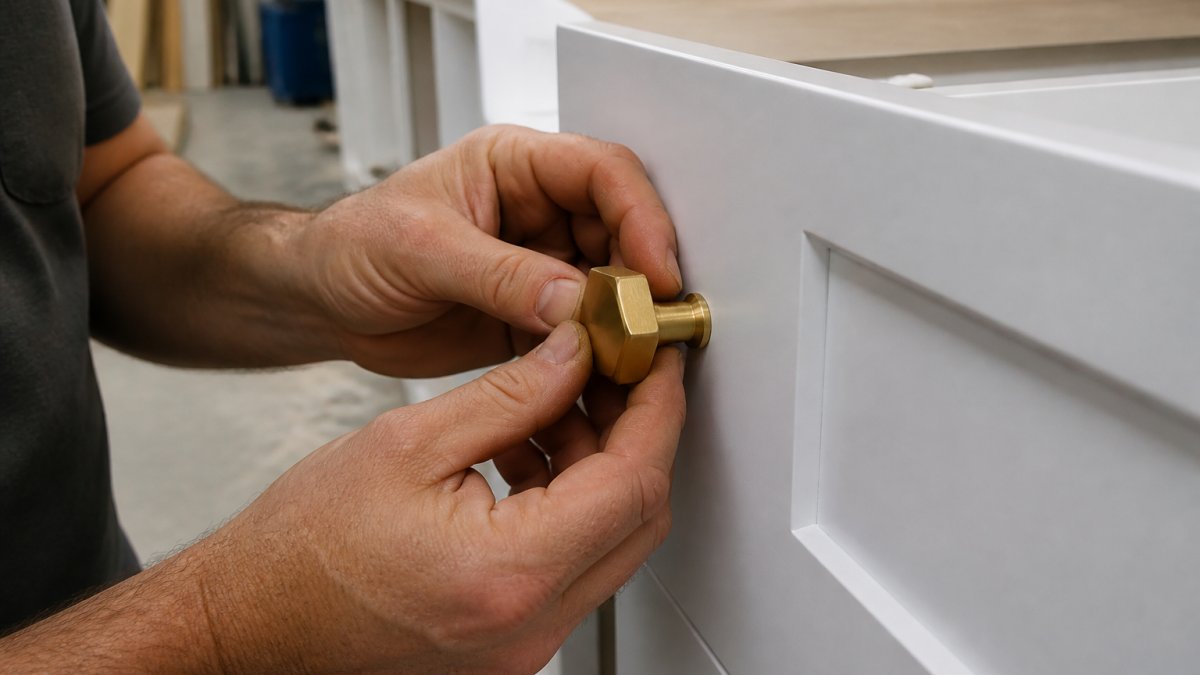
Brass and Gold Finishes
Brushed brass is a warm choice for white kitchens. It adds warmth without shouting. Our Cabinet Knob Hexagonal Solid Brushed Brass is £3.52 per knob, solid brass, 34 mm across with a 21 mm height.
Antique and burnished brass carry more character and suit traditional and heritage schemes.
Watch out: brass with a lacquered finish can discolour where steam sits on it. Wipe splash zones down rather than leaving residue to settle.
Black, Nickel and Chrome
Matt black provides contrast against white doors and reads as contemporary. Our Cabinet Pull Handle Hafele Matt Black Door Handle starts at £13.17, and the matching Cabinet Knob Hexagonal Solid Brass Matt Black is £3.84.

Brushed nickel sits between brass and chrome in tone. The Cabinet Pull Handle Hafele Brushed Nickel Solid Handle starts at £1.52, the value pick in this range.

Polished chrome has a highly reflective finish and suits sharp, minimal schemes.
Kitchen Cabinet Knobs and Handles: The Full Comparison Table
Knobs suit drawers and small doors; pulls suit wide doors where a single grip point would strain the hinge.
| Product | Type | Finish | Size | Price |
|---|---|---|---|---|
| Hexagonal Solid Brushed Brass | Knob | Brushed brass | 34 mm dia. | £3.52 |
| Hexagonal Solid Brass Matt Black | Knob | Matt black | 34 mm dia. | £3.84 |
| Hexagonal Brass and Black | Knob | Black with brass edge | 34 mm dia. | £3.96 |
| Mushroom Double Ring | Knob | Antique or brushed brass | 30 x 32 mm | £10.77 |
| Slender Long Slim Pull | Pull | Black, white or brushed gold | 1200 mm | £19.27 |
| Polished Chrome Square D | Pull | Polished chrome | 128-320 mm | £2.34 |
| Hafele Brushed Nickel T Bar | Pull | Brushed nickel | 96-758 mm centres | £1.52 |
| Hafele Matt Black | Pull | Matt black | 128-492 mm centres | £13.17 |
| Leaf Collection Cup | Cup pull | Brushed antique brass | 87-162 mm | £7.95 |
| Carlisle Brass Victorian Cup | Cup pull | Satin nickel | 76 mm centres | £11.04 |
How to Choose Kitchen Cabinet Handles for a White Kitchen
Start with the door, not the handle. Shaker and bevelled doors take a knob well. Flat slab doors usually need a pull to break up the surface.
Then decide how much contrast you want. Brass reads warm and traditional; matt black reads sharp and modern.
For a wider look at styles and finishes before you commit, our kitchen cupboard door handles guide covers the full range of options.
Three practical rules for fitters:
- Match every metal in the room, including taps and sockets, or deliberately contrast exactly one
- Choose the finish before you drill, not after
- Order one spare per ten units for future damage
Kitchen Cabinet Handle Sizes and Fixing Measurements
Handle size is where most orders go wrong. The measurement that matters is the fixing centres, the distance between the two screw holes, not the overall length. A pull listed as 160 mm overall might have 128 mm centres, and those 32 mm decide whether it covers your existing drill holes.
How to measure before you order
- Remove one existing handle and measure from the centre of one screw hole to the centre of the other. That is your centre-to-centre (c/c) measurement.
- Measure the door or drawer front thickness with a ruler or calipers, most standard British cabinet doors are 18 mm to 22 mm, but larder and pan drawers can run thicker.
- Note the projection: how far the handle stands off the door face. Knobs typically project 20-35 mm; pulls usually 30-40 mm.
- Check the backplate or rose diameter if you are covering old marks. A backplate wider than the old footprint hides paint rings and faded patches.
Matching our range to your existing holes
Our Cabinet Pull Handle Slender Long Slim Door Pull Handle runs 1200 mm long, 7.5 mm wide and 25 mm high, and suits door thickness up to 25 mm. You can check the slim pull handle dimensions against your cabinet measurements before ordering.

The Hafele Brushed Nickel T Bar covers fixing centres from 96 mm to 758 mm across several sizes.
The Hafele Matt Black pull covers 128 mm to 492 mm centres, again in stepped sizes. If your existing holes are at 160 mm, order the 160 mm-centre version and the screws drop straight in.
Our hexagonal knobs are fitted with a single fixing; they project 21 mm.
Screws, backplates and avoiding new holes
Cabinet handles are supplied with fixing screws; check each listing for the screw length included. Door thickness plus handle base usually needs 25 mm for standard 18 mm doors and 40 mm where the door is thicker or a backplate is fitted. If the supplied screws are too long they will break through the inside face, shorten them with a hacksaw or add a washer rather than forcing them.
Quick reference: what to record per unit
- Centre-to-centre of existing holes (pulls only)
- Door or drawer front thickness
- Projection you can live with (deeper pulls catch on adjacent doors in tight runs)
Write these down per cabinet before you order. It takes twenty minutes and prevents the most common second order of the project.
Cabinet Knob Hexagonal Solid Brushed Brass →
Durability, Finish Wear and Keeping Hardware Clean
Kitchen hardware lives in a hard environment: steam, grease, heat cycling and constant handling. This section covers how each finish behaves after a year of cooking, and how to clean it without stripping the coating.
How the main finishes wear
Solid brass, unlacquered. Develops a patina that darkens and mottles over time.
Brushed brass, lacquered. The brushed grain hides fingerprints and light grease well.
Matt black, powder-coated or plated. Excellent at hiding fingerprints and grease because the surface is non-reflective.
Polished chrome. Reflects everything, including every mark, water spot and fingerprint. Durable and corrosion-resistant, but it needs wiping more often than any other finish.
A simple comparison method you can repeat at home
A few weeks of normal use tells you more than any lab test. To compare finishes fairly:
- Fit one handle of each candidate finish to a high-use cabinet, usually the bin drawer or the kettle cupboard.
- Wipe each with a damp cloth once a day and note how quickly fingerprints and grease reappear.
- After a month, check edges and screw recesses for chipping, clouding or discolouration.
- Clean one handle with a mild soap solution and one with a proprietary spray, and compare the finish afterwards.
This is not a laboratory test, but it reflects real kitchen conditions better than a showroom display.
Cleaning guidance by finish
- Brushed brass and lacquered brass: damp cloth and mild soap, dry immediately. Avoid abrasive creams, bleach-based sprays and anything labelled as a descaler.
- Unlacquered brass: the same, plus an occasional brass polish if you want to reset the patina. Test on a hidden face first.
- Matt black: damp cloth only. Avoid scouring pads, which leave shiny marks on a matt surface.
Batch variation and spares
Applied finishes vary between batches, and that is normal. Some product listings note that applied finishes may vary from batch to batch. Order 10% spares at the same time as the main run so any future replacement matches. Store them in the original packaging, away from damp, until needed.
Price and Value: What Each Option Costs Per Unit
Budget per unit, then multiply by door and drawer count.
At the low end, the Hafele Brushed Nickel T Bar at £1.52 and the Polished Chrome Square D at £2.34 are the lowest-priced options.
The Mushroom Double Ring knob at £10.77 and the Leaf cup handle at £7.95 are statement pieces.
The Hafele Brushed Nickel T Bar is a steel option available in several sizes.
Ordering the Right Hardware First Time
Order everything in one go, from one batch, with the measurements written down. Our tips for installing kitchen cabinet fittings help you avoid ordering mistakes and fit the hardware correctly once it arrives.
A short checklist before checkout:
- Count every door and drawer, then add 10% spares
- Record fixing centres for each pull, not overall length
- Confirm door thickness against the handle specification
Some of our brass collections are special order; the Leaf and Mushroom Double Ring listings give an availability of around two weeks from the date of placing an order. Check that against your project schedule before you commit.
Frequently Asked Questions
What colour cabinet hardware looks best on white kitchen cabinets?
There is no single answer, but the finish changes the mood. Brushed brass and antique brass add warmth and suit both traditional and modern doors. Matt black gives sharp contrast and reads as contemporary. Brushed nickel and polished chrome stay quiet and blend into the white, which suits minimal schemes. If the kitchen has other metals, such as a tap or pendant lights, pick a hardware finish that either matches or deliberately contrasts with them rather than sitting in between.
Are knobs or handles better for white kitchen cabinets?
It depends on the door style and how the kitchen is used. Knobs suit shaker and traditional doors and are cheaper per unit, with the hexagonal solid brass knob at £3.52 being a good example. Handles give a longer grip, which helps on wide drawers and tall larder doors, and they read as more contemporary. Many kitchens mix both: knobs on doors, pulls on drawers. Whichever you pick, keep the finish consistent across the whole run.
How do I choose the right size handles for kitchen cabinets?
Start with the fixing centres, not the overall length. A handle listed as 168 mm long with 128 mm centres needs the two screw holes 128 mm apart, so measure your existing drilling before ordering. Check the fixing centres against your existing holes, and check the projection so the pull clears the door face and does not catch on adjacent units.
Do black handles look good on white kitchen cabinets?
Yes, and it is one of the most reliable pairings. Matt black on white creates strong contrast without the busy look of a patterned finish. The Hafele matt black pull handle is priced at £13.17 and the hexagonal matt black brass knob at £3.84. One practical note: matt black shows fingerprints and grease more than brushed finishes, so wipe them down regularly, particularly around the hob and sink.
Should kitchen cabinet handles match the tap?
Matching is optional, but coordination matters. A brushed brass tap with polished chrome handles looks accidental rather than designed. Either repeat the tap finish in the hardware or choose a finish that is clearly different, such as black hardware against a nickel tap. If you are fitting a whole kitchen, settle the tap and hardware finishes together before drilling any doors, because changing your mind later means new holes or filler.
Getting the finish right first time is the difference between a kitchen that looks finished and one that looks almost finished. FixFit supplies Blum, Hafele, GTV, Sugatsune and Tutti hardware with the stock and specification detail to match, backed by a team that works in joinery rather than a call centre. Get started with FixFit and order your cabinet hardware with the measurements confirmed before you drill.
