

Concealed vs Surface Mount Hinges Explained
Table of Contents
- Concealed vs Surface Mount Hinges Explained: Key Differences
- Types of Cabinet Hinges You Need to Know
- Overlay vs Inset Cabinet Doors: Which Hinge Fits?
- Concealed Hinge Installation: What the Job Actually Involves
- Cabinet Hinge Adjustment: Getting Doors Sitting Right
- When Surface Mount Hinges Are the Better Choice
- Frequently Asked Questions
Last Updated: October 12, 2026
Concealed vs Surface Mount Hinges Explained: Key Differences
Concealed vs surface mount hinges explained comes down to one question: do you want the hinge visible or hidden? Concealed hinges sit inside a recess cut into the door and frame, so nothing shows when the door is closed. Surface mount hinges fix to the face of the door and frame, leaving the knuckle and plates on show. That single difference drives everything else, from the tools you need to the look you get. This guide from FixFit walks through both types, where each belongs, and how to choose.
Concealed hinges are fittings installed within a recess in the door and frame, leaving no visible hardware when the door is shut. Surface mount hinges are fixed directly to the face of the door and frame, so the hinge body stays visible in use.
The trade-off is straightforward. Concealed hinges give you a clean, minimalist finish and three-way adjustment on most professional models. Surface mount hinges install faster, cost less, and suit doors where you cannot cut a deep recess. Neither is universally better. The right pick depends on door thickness, weight, finish expectations, and whether the door is rebated or flush-faced.
Here is what most guides miss: the hinge type should follow the door, not the other way round. Choose the door build first, then match the hinge to it.
Types of Cabinet Hinges You Need to Know
Cabinet hinges split into a few working families, and knowing which one you are holding saves a wasted order. The main types of cabinet hinges are concealed cup hinges, face-fix compact hinges, surface-mounted hinges, and flush door hinges for heavier timber doors.
- Concealed cup hinges sit in a 35mm bore in the door and suit overlay or inset cabinet doors.
- Face-fix compact hinges fix to the frame face and work well on overlay doors with thinner sections.
- Surface-mounted hinges show on the door face and need no boring.
- Flush door hinges handle un-rebated timber doors on wardrobes and cabinets.
For overlay work, the Blum 38B355AF22 Sprung Compact Face Fix Hinge mounts within a 35mm hole and gives a 107-degree opening with height adjustment of +/- 3.2mm and depth adjustment of +/- 2mm. It suits door thicknesses from 16mm to 24mm.

If you need more travel, the Ceam 3D Cabinet Concealed Adjustable Hinges 929 open to 180 degrees and work with inset or lay-on doors from 18mm thick. Adjustment is on three axes with a 2.5mm Allen key, and the cover plates hide the screws.
Overlay vs Inset Cabinet Doors: Which Hinge Fits?
Overlay vs inset cabinet doors decide your hinge faster than any other factor. An overlay door sits in front of the cabinet frame and covers it. An inset door sits flush within the frame opening, so the door face lines up with the carcass.
Overlay doors are the easier job. The door covers the frame edge, so small alignment errors stay hidden, and compact face-fix hinges handle most builds. Inset doors demand more precision because the gaps around the door are visible on all four sides. That is where three-way adjustable concealed hinges earn their price.
| Door type | Hinge to use | Adjustment needed | Difficulty |
|---|---|---|---|
| Overlay | Compact face-fix or cup hinge | Height and depth | Straightforward |
| Inset | 3D concealed hinge | Height, depth, side | High precision |
| Flush timber door | Concealed flush hinge | 3D, behind covers | Trade level |
The Ceam 929 handles both inset and lay-on doors, which makes it a sensible choice if your workshop runs a mix of both. It carries up to 12kg on two hinges, 16kg on three, and 21kg on four.

Concealed Hinge Installation: What the Job Actually Involves
Concealed hinge installation starts with a bored cup, and that bore is the whole job. Get the 35mm hole in the right place and the rest is adjustment. Miss it, and you are filling and re-drilling.
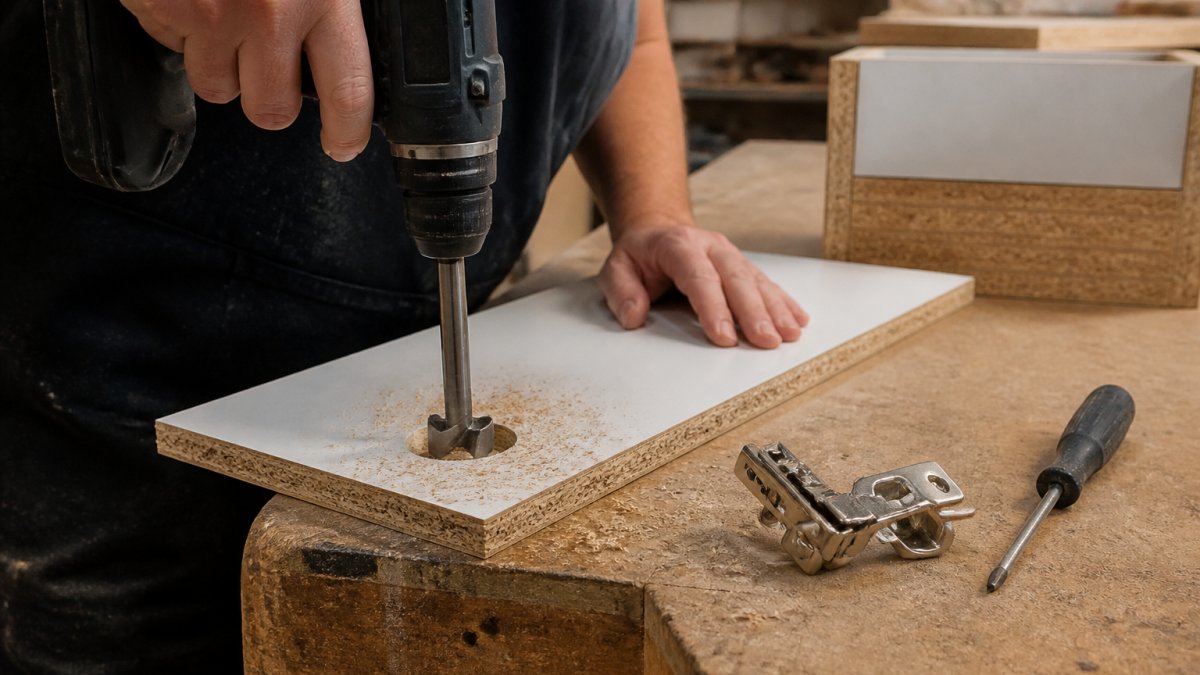
The sequence runs like this:
- Mark the cup position on the door using the hinge's own template or a boring jig.
- Bore the 35mm cup to the depth the hinge specifies.
- Screw the hinge body into the cup.
- Fix the mounting plate to the cabinet frame.
- Clip the door onto the plate and check the reveal.
- Adjust on all available axes until the gaps are even.
For flush timber doors the job changes. The Sugatsune HES 150 concealed hinge mounts on the surface of un-rebated flush doors and hides the fixings behind clip-on cover plates. It gives a 110-degree opening on 35mm doors, and the adjustment bolts sit behind the covers. Two hinges carry 40kg, three carry 50kg.
The HES 140 is the heavier option, opening to 125 degrees on 38mm doors, with two hinges rated to 50kg and three to 65kg. Both have passed a 300,000 open and close cycle test.
Concealed Surface Mounted Sugatsune HES 150 Door Hinge →
Cabinet Hinge Adjustment: Getting Doors Sitting Right
Cabinet hinge adjustment fixes almost every door that hangs wrong, and you rarely need to move a screw hole. Most complaints about sagging, rubbing, or uneven gaps trace back to adjustment, not fitting.
Work through the axes in order:
- Height: moves the door up or down to level the top and bottom gaps.
- Depth: pulls the door in or out to sit flush with the carcass.
- Side: shifts the door left or right to even the vertical gaps.
On the Blum compact hinges, height adjustment is +/- 3.2mm and depth is +/- 2mm. On the Ceam 929, all three axes adjust with a single 2.5mm Allen key, and the cover plates pop off to reach the screws. The Sugatsune HES hinges hide their adjustment bolts behind covers that slip on and off without tools.
When Surface Mount Hinges Are the Better Choice
Surface mount hinges win when the door cannot take a recess, when speed matters, or when the budget is tight. There is no boring, no cup depth to get right, and no template to set. You fix the hinge to the face and move on.
They suit several common jobs:
- Doors too thin for a 35mm cup
- Retrofit work on existing cabinets where you cannot cut new recesses
- Low-cost furniture and utility cabinets
- Situations where a visible hinge suits the style
The catch is the look. A surface mount hinge stays on show, which rules it out for high-end bespoke work where the client expects a clean face. It also offers fewer adjustment axes on most models, so it forgives less on an inset door.
If the door is a quality flush-faced timber door and the finish matters, go concealed. If the door is a utility carcass door and the job needs to move, surface mount is the sensible call.
Choosing between concealed and surface mount hinges is really a question about the door in front of you: its thickness, its weight, and how much of the hardware the client is willing to see. Get that wrong and you will be re-drilling cups or explaining visible knuckles on a bespoke job. At FixFit we stock the concealed hinges that do the hard work, including the Sugatsune HES range with three-way adjustment and 300,000-cycle durability, the Blum compact face-fix hinges, and the Ceam 929 for inset and lay-on doors. Our trade team can help you match the hinge to the door spec before you order, so you get the right product first time. Subscribe to our emails for stock updates and fitting guidance.
Frequently Asked Questions
What is the difference between concealed and surface-mount hinges?
Concealed hinges sit inside a bored hole in the door and frame, so no hardware shows when the door is closed. Surface-mount hinges screw onto the face of the door and frame, leaving the knuckle and plates visible. Concealed options such as the Sugatsune HES 150 give a clean, flush finish and 3D adjustment, while surface-mount types are quicker to fit and easier to swap on older or solid carcasses.
Do concealed hinges need a special hole drilled in the cabinet door?
Yes. Most concealed cabinet hinges need a 35mm bored hole in the door for the hinge cup, which is why a Forstner bit and a drill press or boring jig are standard kit in a joinery workshop. Some surface-mounted concealed hinges, like the Sugatsune HES 140, fix to the door face instead and suit un-rebated flush doors where a cup bore is not practical.
Can you adjust concealed cabinet hinges?
Most can be adjusted on two or three axes. The Blum 38B355AF22 offers +/- 3.2mm height and +/- 2mm depth adjustment, while the Ceam 929 adjusts on three axes with a 2.5mm Allen key. The Sugatsune HES 140 and HES 150 have 3-way adjustment with the bolts hidden behind clip-on covers, so you can correct door gaps and alignment without stripping the hinge off.
Can you replace surface-mount hinges with concealed ones?
Sometimes, but it depends on the door and carcass. You need at least 18mm door thickness for a cup bore, and the frame must accept the hinge arm without fouling. The Ceam 929 works with carcasses and doors from 18mm thick and suits inset or lay-on doors, so it is a common upgrade path. On thin or hollow doors, stay with surface-mount fittings.
When should you use surface-mount hinges instead of concealed?
Use surface-mount hinges on thin doors, hollow-core doors, or where a cup bore would weaken the stile. They also suit retrofits where you cannot rebate or bore the existing frame. For heavy doors up to 65kg, the Sugatsune HES 140 gives a concealed look with surface-mount fixing, so you get the aesthetic without the full cup-bore setup.