

How to Fix Common Cabinet Hinge Problems
Last Updated: October 25, 2026
Quick Summary
The most common cabinet hinge problems are sagging or dropped doors, squeaking and stiff movement, screws that will not hold in stripped holes, soft-close dampers that stop working, and doors that will not align because of a bent arm or cracked cup. Most faults come down to one of five causes, and many need only a screwdriver and ten minutes rather than a new hinge.
- Turn each adjusting screw a quarter turn at a time, as over-adjusting is the most common mistake.
- If a fixing screw turns with light finger pressure, the thread has nothing to bite into.
- A stripped screw hole can be filled and re-drilled or covered with a stainless steel repair plate.
- Check the damper switch on the arm before assuming a soft-close hinge has failed.
- Replace the hinge when the arm is bent, the cup is cracked or the spring has snapped.
Table of Contents
- Why Cabinet Hinges Fail: The Problems You Will Actually See
- How to Adjust Cabinet Hinges to Realign a Dropped Door
- Loose Cabinet Hinge Repair: Fixing Screws That Will Not Hold
- Soft-Close Cabinet Hinge Not Working: Diagnosing the Damping Fault
- Cabinet Hinge Replacement: Knowing When to Swap Instead of Fix
- Warped Doors and Hinge Strain: When the Door Is the Problem
- Ordering the Right Hinge Parts from FixFit
- Frequently Asked Questions
Why Cabinet Hinges Fail: The Problems You Will Actually See
Most cabinet hinges fail for one of five reasons: worn screws, stripped screw holes, tired dampers, bent arms or a warped door. Knowing which one you are looking at saves you from replacing a hinge that only needed adjusting. At FixFit, we supply hinges and repair parts to joinery workshops and fitters, and the same handful of faults come up again and again. Below, we break down each problem and the fix that actually works.
Sagging doors and dropped alignment
A sagging door is nearly always an adjustment problem, not a broken hinge. The door has drifted down because the fixing screws have loosened or the adjustment cams have shifted under load.
You will spot it fast: the top edge catches the carcass, the gaps around the door are uneven, and the door no longer sits flush with its neighbour. On a run of units, one dropped door makes the whole kitchen look tired.
The good news is that most sagging doors need a screwdriver and ten minutes, not a new hinge. We cover the exact adjustment sequence in the next section.
Squeaking, sticking and stiff movement
Noise and stiffness point to friction. The usual culprits are:
- Dry or dirty hinge joints
- Paint or varnish sprayed into the hinge knuckle during a refurb
- A hinge arm rubbing against the cabinet side
- Loose screws allowing the door to shift as it swings
A quick clean and a drop of light oil solves most squeaks. If the hinge still sticks after cleaning, check that the door is not binding against the carcass. Sticking that appears only at the end of the swing often means the hinge is near the limit of its adjustment range.
Most hinge faults come down to one of five causes, each with its own fix.
| Problem | Cause | Fix |
|---|---|---|
| Sagging or dropped door | Loosened fixing screws or shifted adjustment cams | Adjust the hinge with a screwdriver |
| Squeaking or stiff movement | Dry or dirty joints, paint in the knuckle, rubbing arm | Clean and apply a drop of light oil |
| Screws that will not hold | Stripped screw holes in the chipboard | Longer screw, fill and re-drill, or repair plate |
| Soft-close not working | Failed damper, damper switch off, wrong door weight | Check switch, then fit a damper catch |
| Door will not align | Bent arm, cracked cup, snapped spring, corrosion | Replace the hinge |
| Hinges keep loosening | Warped door fighting the hinge | Door straightener or replacement door |
How to Adjust Cabinet Hinges to Realign a Dropped Door
Learning how to adjust cabinet hinges comes down to three screws on most European-style hinges. Each one controls a different direction of movement, and turning the wrong one makes the problem worse.
Here is the sequence we recommend:
- Identify the screws. The mounting plate screws fix the hinge to the carcass. The adjusting screws sit on the hinge arm and cup.
- Loosen, do not remove. Back the mounting plate screws off by half a turn so the plate can slide.
- Set the height. Slide the plate up or down to level the door with its neighbour, then tighten.
- Close the gap. Turn the side adjustment screw clockwise to pull the door towards the carcass, anticlockwise to push it away.
- Fine-tune the overlay. The cam screw on the cup adjusts how far the door sits over the carcass edge.
- Test the swing. Open and close the door several times before you walk away.
Turn each screw a quarter turn at a time. Small movements add up quickly, and over-adjusting is the most common mistake we see. If the door will not hold its position after adjustment, the screws are the problem, not the settings.
Loose Cabinet Hinge Repair: Fixing Screws That Will Not Hold
Loose cabinet hinge repair starts with the screws, because a screw that turns without gripping cannot hold an adjustment. If you can turn a fixing screw with light finger pressure, the thread has nothing to bite into.
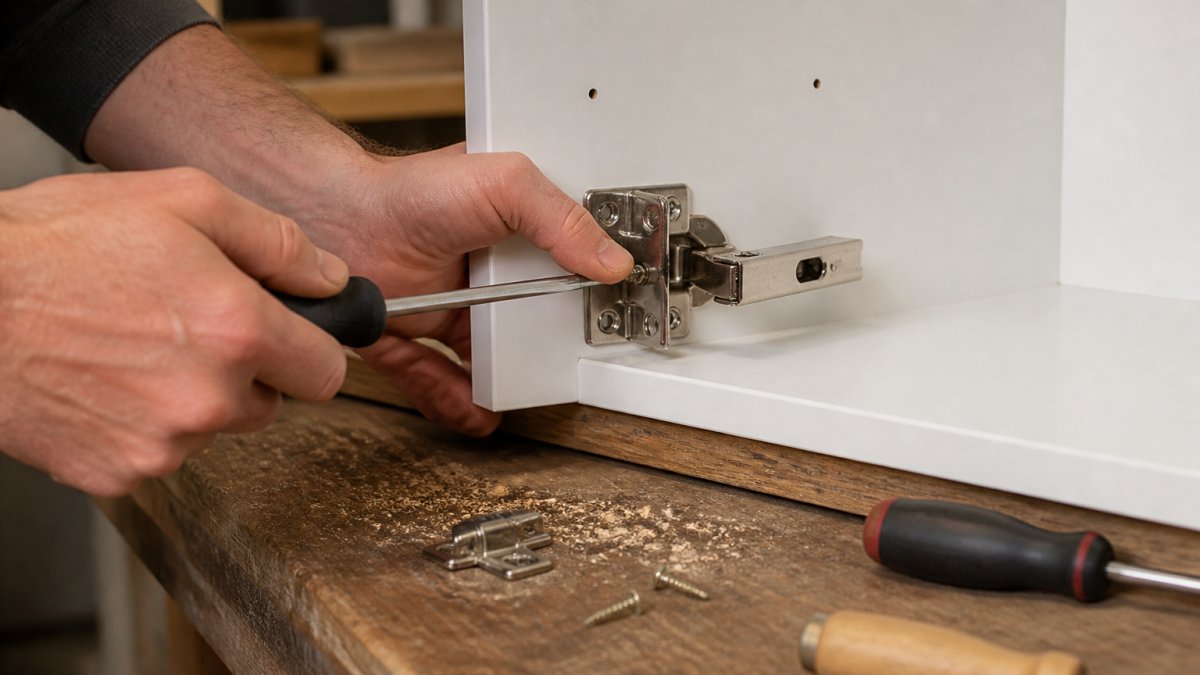
First, try a longer screw of the same gauge. Euro hinges use specific screw types, and the wrong profile chews the hole. Our Blum Ø6mm Euro hinge system screws are made for exactly this job and give a clean, reliable fixing in the standard mounting plate holes.
If a longer screw still spins, the hole itself has failed.
When the screw holes are stripped
A stripped hole means the chipboard around the screw has crumbled. You have two options, and both beat replacing the carcass.
Option one: fill and re-drill. Push a hardwood plug or two-part wood filler into the hole, let it set, then drill a pilot hole and refit the screw. This works well for a single failed hole.
Option two: fit a repair plate. A stainless steel plate spreads the load across sound material either side of the damaged hole. Our cabinet hinge repair plates set includes two plates and the correct screws, and fits all brands of mounting plate. It is the faster fix when several holes have gone, and it adds real strength back into the carcass.

Watch out: never overtighten the new screws. Over-tightening crushes the chipboard and strips a fresh hole in seconds.
Hinge Repair Plate HRPSM Mounting Plate Side →
Soft-Close Cabinet Hinge Not Working: Diagnosing the Damping Fault
A soft-close cabinet hinge that has stopped damping is usually a failed damper, not a broken hinge body. The door slams, or it closes softly for the first part of the swing and then drops.
Check these in order:
- Is the damper switch on? Many hinges have a small on/off slide on the arm. It may have been knocked.
- Is the door too light or too heavy? Dampers are rated for a door weight range. A mismatch shows up as weak or no damping.
- Has the damper worn out? Dampers contain a piston that loses resistance over years of use. This is normal wear.
If the damper has failed, you do not always need a full hinge. On small doors, a Sugatsune Lamp soft close damper catch for small doors restores the soft-close action. For heavier doors, the heavy-door version gives the extra resistance a large panel needs. Both fit as a straightforward add-on, which is often cheaper than swapping every hinge on the run.
Cabinet Hinge Replacement: Knowing When to Swap Instead of Fix
Replace the hinge when the metal itself has failed. Adjustment and repair only work on sound hardware.
Swap it out if you see any of these:
- A bent or twisted hinge arm that will not straighten
- A cracked cup or a snapped spring
- Rust or heavy corrosion on the hinge body
- A hinge that has been adjusted to its limit and still will not align the door
Matching the replacement matters more than most people expect. Note the overlay type, the cup size and the mounting pattern before you order. A full overlay hinge like the Blum 71B3550 soft close 110 full overlay hinge suits standard kitchen units, but check your existing hinge against the spec first.
A common mistake is buying a like-for-like hinge from a different brand and finding the screw holes do not line up. Measure the mounting plate centres before you commit.
Warped Doors and Hinge Strain: When the Door Is the Problem
Sometimes the hinge is fine and the door is not. A warped door fights every hinge on it, and no amount of adjustment will fix a panel that has twisted.
Signs the door is at fault:
- The gap between door and carcass changes along its height
- The door bows away from the carcass in the middle
- Hinges keep loosening even after repair
- The door catches at one corner no matter how you adjust it
Solid timber and large panels warp with changes in moisture and heat. For a door that has twisted but is otherwise sound, a door straightener adds rigidity back into the panel and can pull a warp out over time. Our recessed door straightener for warped panel doors suits panels from 16 mm to 22 mm thick, and we recommend two sets per door on anything wider than 600 mm.
If the warp is severe or the panel has delaminated, replacement is the honest answer. Hanging a new door on strained hinges just moves the problem along.
Ordering the Right Hinge Parts from FixFit
Getting the right part first time is the difference between a ten-minute fix and a week of waiting on a return. FixFit, run by Debonair Joinery, stocks hinges and repair parts from Blum, Häfele, GTV, Sugatsune and Tutti, so trade buyers and DIY customers order from the same catalogue.
Before you order, note three things:
- The hinge brand and model, if it is stamped on the arm
- The cup diameter, usually 35 mm on kitchen units
- The overlay type: full, half or inset
Send us a photo of the hinge if you are unsure. Our team checks specs against your project rather than guessing, which is how we aim to get it right, first time, every time.
Frequently Asked Questions
Why does my cabinet hinge keep coming loose?
The most common cause is screw holes that have stripped out of the chipboard or MDF carcass, usually from repeated door opening or over-tightening during fitting. Once the thread grip is gone, no amount of re-tightening will hold. Fitting a hinge repair plate spreads the load across a wider area of the carcass and gives the screws fresh material to bite into, which is a far cheaper fix than replacing the cabinet side panel.
Can a broken cabinet hinge be repaired, or should it be replaced?
It depends on what has failed. If the hinge is loose, squeaking or slightly out of alignment, adjustment or a repair plate will usually sort it. If the hinge arm is bent, the cup is cracked or the soft-close mechanism has failed internally, replacement is the sensible route. Cabinet hinge replacement is straightforward when you match the cup size, usually 35mm, and the mounting plate pattern to the existing fitting.
Why has my soft-close cabinet hinge stopped working?
Soft-close hinges rely on a small internal damper filled with fluid. Over thousands of cycles the seal can wear, the fluid escapes and the door slams again. If the hinge is a sealed, non-serviceable type, replacing the hinge itself is the practical answer.
How do I stop a cabinet door from squeaking?
Squeaking almost always comes from metal-on-metal contact at the hinge joints or from a hinge that has worked loose. Tighten the fixing screws first, then apply a small amount of silicone or white lithium grease to the pivot points rather than a general-purpose oil, which attracts dust. If the squeak persists after tightening and lubricating, the hinge is likely worn and due for replacement.
Cabinet hinge problems rarely need a full refit. Most come down to a stripped screw hole, a tired damper or a door that has drifted out of alignment, and each has a straightforward fix. FixFit supplies the repair plates, dampers and replacement hinges to sort them, backed by a team that knows joinery hardware inside out. Get started with FixFit and order the right part first time.
