

Blum vs Hafele Hinges for Kitchen Cabinets
Table of Contents
- Blum vs Hafele: What Actually Separates These Kitchen Cabinet Hinges
- Blum vs Hafele Hinges at a Glance
- Blum ClipTop Blumotion: The 71B3550 Range in Detail
- Mounting Plates and Cross-Brand Compatibility
- How to Adjust Soft Close Cabinet Hinges on Both Brands
- Replacing Kitchen Cabinet Hinges: Matching the Old Drilling Pattern
- Which Brand Should You Fit?
- Frequently Asked Questions
Last Updated: October 4, 2026
Blum vs Hafele: What Actually Separates These Kitchen Cabinet Hinges
Walk into any joinery workshop and you will hear the same debate: Blum or Hafele? Both are Austrian-engineered giants, both are stocked by suppliers across the trade, and both will outlast the cabinet they are fitted to. The real question when comparing Blum vs Hafele hinges for kitchen cabinets is not which brand is "better" in the abstract. It is which hinge suits the door you are hanging, the drilling pattern already in the carcass, and the budget your client has signed off.
At FixFit, we supply both brands alongside GTV and Sugatsune. The short answer: Blum leads on adjustment precision and integrated soft-close engineering, while Hafele spreads its range across a wider price band and leans on its distribution network. Below, we break down the differences that matter at the bench, plus how to adjust soft close cabinet hinges on either brand once they are fitted.

Blum vs Hafele Hinges at a Glance
The practical difference between the two comes down to three things: how the soft-close mechanism is built in, how much adjustment travel you get, and how easy it is to match an existing drilling pattern. Blum's ClipTop Blumotion range integrates the damper into the hinge boss itself, which keeps the cup profile compact (CLIP top BLUMOTION). Hafele sources across several ranges, so the specification you get depends heavily on which line your supplier holds in stock.
| Feature | Blum ClipTop Blumotion | Hafele (varies by range) |
|---|---|---|
| Soft-close | Integrated in hinge boss | Integrated on most current lines |
| Opening angle | 110° on the 71B3550 | 100°-110° depending on range |
| Side adjustment | +/-2mm via spiral screw | Typically +/-2mm |
| Depth adjustment | +3/-2mm, infinitely variable | Range dependent |
| Cup size | 35mm standard | 35mm standard |
| Best for | Spec-critical bespoke work | Volume fit-outs, mixed budgets |
The table tells you the headline story, but it hides the detail that actually bites on site. Adjustment travel matters more than opening angle when you are hanging a heavy solid-timber door that has moved slightly since it was sprayed.
Blum ClipTop Blumotion: The 71B3550 Range in Detail
Blum's 71B3550 is the hinge most joiners reach for on full-overlay kitchen doors. The Blumotion damper sits discreetly in the hinge boss, so the cup stays compact and the door closes silently regardless of front weight or closing speed. That last point is the one people underestimate: a soft-close mechanism that only works on light doors is worse than no soft-close at all, because it fails inconsistently.
The Blum 71B3550 Soft Close 110° Full Overlay Cabinet Hinge gives you three-dimensional adjustment: +/-2mm side travel and +3/-2mm depth via a spiral screw. Doors up to 24mm thick are supported, which covers most painted MDF and veneered fronts. It is supplied as the hinge only, so you will need to add a mounting plate.
If you want the whole fixing in one box, the Blum Soft Close 110° Full Overlay Black Cabinet Hinge Set includes the hinge, mounting plate, cover cap and four black wood screws. That set is the sensible choice for dark carcasses where a nickel hinge would stand out.

Mounting Plates and Cross-Brand Compatibility
Mounting plates are where brand loyalty becomes a physical constraint. A Blum hinge will not clip onto a Hafele plate, and a Hafele hinge will not clip onto a Blum plate. The clip geometry differs between manufacturers, and the plate height determines your overlay calculation, so mixing brands mid-project means recalculating every door.
This is a common mistake from joiners switching suppliers mid-job. They order hinges from one source and plates from another, then discover the two will not marry up. If you are replacing kitchen cabinet hinges on an existing carcass, check the plate already screwed to the cabinet side before you order anything. Match the plate, and the hinge follows.
There is one more wrinkle worth knowing. Plate height, not hinge brand, sets your door overlay. A 0mm plate and a 3mm plate on the same hinge will hang the door in different positions. Get the plate wrong and no amount of hinge adjustment will close the gap cleanly.
How to Adjust Soft Close Cabinet Hinges on Both Brands
Adjusting soft close cabinet hinges on either brand follows the same three-axis logic, because both use a cam or spiral screw for side, height and depth. The sequence matters: set depth first, then side, then height, and only touch the soft-close mechanism last.
- Depth adjustment moves the door toward or away from the carcass. On Blum, turn the spiral screw; the 71B3550 gives +3/-2mm of infinitely variable travel.
- Side adjustment shifts the door left or right to even up the gaps. Both brands typically offer +/-2mm here.
- Height adjustment is usually made at the mounting plate, via a cam, rather than at the hinge itself.
- Soft-close speed, where the range allows it, is set by a separate screw on the damper. Turn it only after the door is aligned.
A door that closes hard on one side and softly on the other almost always has a depth problem, not a damper problem. Fix the alignment before you touch the soft-close setting, or you will chase the fault around the door.
Replacing Kitchen Cabinet Hinges: Matching the Old Drilling Pattern
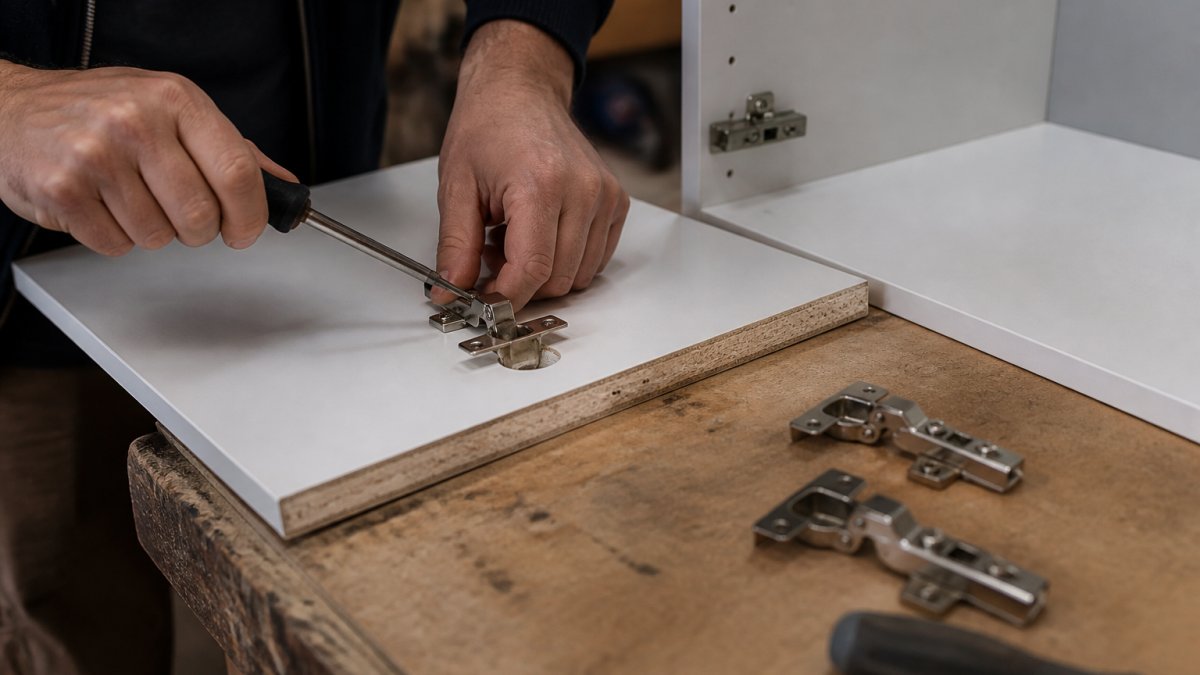
Replacing kitchen cabinet hinges is straightforward when the new hinge uses the same 35mm cup and the same plate fixing centres. Almost every modern European hinge, Blum and Hafele included, uses a 35mm cup bore, so the door itself rarely needs re-drilling. The plate is the variable.
Blum 71B3550 Soft Close 110° Full Overlay Cabinet Hinge →
Before ordering, measure three things: the cup diameter, the distance from the cup edge to the plate screw holes, and the plate height. If the existing hinge is a Blum ClipTop, a like-for-like Blum replacement drops straight in. If it is an older or unbranded hinge, you may need to redrill the plate position, which is a five-minute job with a bradawl and a steady hand.
For inset doors, the geometry changes entirely. The GTV Soft Close 100° Inset Cabinet Hinge is certified for 80,000 cycles and comes with a cruciform mounting plate in the pack, which makes it a practical option when a client wants inset fronts without the Blum price tag.
Which Brand Should You Fit?
Fit Blum when the specification is tight, the doors are heavy, and the client will notice a soft close that works every time. The 71B3550's integrated Blumotion and its depth travel make it the more forgiving hinge on solid or spray-finished doors, and the black set solves the dark-carcass problem in one order.
Fit Hafele when you are working to a volume budget and your supplier holds consistent stock across the range you have specified. The trade-off is that Hafele's specification varies more between lines, so you need to read the datasheet for the exact hinge rather than assuming the brand guarantees a fixed set of features.
There is a third option worth knowing about. The GTV Soft Close 100° Full Overlay Cabinet Hinge offers hydraulic soft close with closing-time adjustment at a lower price point, and the Cabinet Hinge Silence Soft Close 100° Full Overlay from the Silento PRO family is rated for 80,000 cycles with a two-way idle movement that protects adjacent doors and walls. For a rental refurbishment or a spec where the hinge will never be seen, that is a defensible choice.

Whatever you fit, buy the hinge and the plate together, from the same range, and check the drilling pattern before you commit the first door. That single discipline prevents more callbacks than any brand decision.
Frequently Asked Questions
Are Blum hinges better than Hafele for kitchen cabinets?
Neither wins outright. Blum's ClipTop Blumotion 71B3550 gives a 110-degree opening angle and three-dimensional adjustment of +/-2mm side and +3/-2mm depth, which suits full overlay doors up to 24mm thick. Hafele covers a similarly wide range across overlay and inset applications. The deciding factor is usually the drilling pattern already in your doors and the mounting plate you can source, not the badge on the hinge.
Do Blum and Hafele hinges use the same mounting plates?
No. Each brand's hinge boss clips onto its own mounting plate system, so a Blum ClipTop hinge will not clip onto a Hafele plate and vice versa. If you are replacing hinges on an existing carcass, check the plate already fitted before ordering. Where the plate is sound, matching the hinge to that plate is quicker than re-drilling every cabinet side.
Which hinge brand offers better soft-close technology?
Blum integrates Blumotion directly into the hinge boss, so the damping works regardless of door weight or how fast the door is pushed shut. GTV's Silento PRO range, an alternative stocked alongside Blum, uses a hydraulic soft-close with closing time adjustment and is certified for 80,000 cycles. Both approach the same result, a silent close from a low opening angle, but Blum's damping is fixed while GTV's can be tuned.
How do I adjust soft close cabinet hinges once they are fitted?
Work in one axis at a time. Use the spiral screw for side adjustment of roughly +/-2mm, then the depth screw, then height. On the Blum 71B3550 the depth range is +3/-2mm. Close the door between each tweak so you can see the effect on the gap. If the door still catches after full adjustment, the mounting plate position is the problem, not the hinge.
What is the expected lifespan of Blum versus Hafele hinges?
Blum does not publish a cycle figure for the 71B3550, and Hafele's figures vary by range, so treat any single number with caution. GTV publishes 80,000 cycles for its inset and Silento PRO hinges, which gives a useful benchmark for what a quality soft-close mechanism should withstand. For domestic kitchens that figure is generous; for commercial fit-outs, cycle rating matters more than brand name.
Choosing cabinet hinges is a small decision that shows up in every door on the job. FixFit, run by Debonair Joinery, stocks Blum, Hafele, GTV and Sugatsune so you can match plate to hinge and get the right fixing first time, backed by trade pricing and a team that knows the difference between a 0mm and a 3mm plate. Subscribe to our emails for stock updates and new range arrivals.