

How to Add Drawers to Existing Cabinets
Last Updated: November 4, 2026
Quick Summary
Yes, you can add drawers to existing cabinets, and most standard kitchen units take them without any structural changes. The job comes down to three checks: carcass condition, internal dimensions and what the cabinet is made from. FixFit supplies runners for this kind of retrofit.
- Check the carcass is square before ordering runners, as a twisted cabinet makes even premium slides bind.
- Side-mount runners typically need around 12.5mm of clearance on each side of the drawer box.
- A typical 600mm unit with 18mm sides gives an internal width of around 564mm, so a 500mm drawer box fits.
- For shelf conversions, a shallow drawer box 100-150mm deep works best for tins, packets and utensils.
- The Blum MOVENTO S Blumotion runners carry 40kg per pair, with locking devices sold separately.
Table of Contents
- Assessing Your Cabinets Before You Add Drawers
- Cabinet Drawer Dimensions and Measurements
- Choosing Drawer Slides for Existing Cabinets
- How to Install Pull-Out Drawers in Existing Cabinets
- Converting Cabinet Shelves to Pull-Out Drawers
- Weight Capacity and Structural Reinforcement
- Troubleshooting and Drawer Front Alignment
- Ordering the Right Drawer Hardware for Your Project
- Frequently Asked Questions
Assessing Your Cabinets Before You Add Drawers
Yes, you can add drawers to existing cabinets, and most standard kitchen units take them without any structural changes. FixFit supplies runners for this kind of retrofit.
Start with a torch and a tape measure. Look for these before you order anything:
- Solid sides: chipboard or ply at least 15mm thick holds screws well. Thin hardboard backs do not.
- Square carcass: measure both diagonals. A difference over 3mm means the cabinet has racked.
- Clear internal depth: the space behind the drawer box, allowing for the runner and any pipework.
A common mistake is ordering runners before checking the carcass is square. A twisted cabinet makes even premium slides bind. The NHBC guidance on kitchen fit-out standards is a useful reference for what counts as an acceptable carcass.
Cabinet Drawer Dimensions and Measurements
Getting the numbers right before you cut anything separates a smooth install from a wasted afternoon. Measure twice, order once.
Measuring cabinet width, depth and height
Measure the internal width between the carcass sides at the top, middle and bottom. Use the smallest figure. For depth, measure from the front edge of the side panel to the back panel. Height runs from the shelf or base to the underside of the worktop or next shelf.
Write everything down in millimetres. Kitchen cabinets are built to metric standards, and mixing imperial and metric measurements is how drawers end up 3mm too wide.
Working out drawer box size and clearance
The drawer box must be narrower than the opening to leave room for the runners. Side-mount runners typically need around 12.5mm of clearance on each side. Under-mount runners sit below the box and need a flat base instead.
Allow for these gaps:
- Side clearance: 12.5mm per side for standard side-mount ball-bearing slides
- Rear clearance: 10-15mm behind the box for the runner carriage
- Top clearance: at least 13mm above the box so it does not foul the worktop
Metric cabinet standards and nominal sizing
Most UK and European system cabinets follow a nominal width convention: a 600mm cabinet has a 600mm external carcass width, not a 600mm internal opening.
Runner lengths are also nominal. A runner sold as 450mm is designed for a cabinet with roughly 450mm of internal depth, but the box itself will be shorter to allow for the rear clearance.
A common pattern in European cabinets is the 32mm system: shelf pins, hinge plates and runner fixings are set on a 32mm vertical pitch.
Measuring for different cabinet types
- Base units: measure from the cabinet floor to the underside of the worktop. Allow for the worktop overhang when checking front clearance.
- Wall units: shallower than base units, so runner length is the limiting factor. Measure internal depth carefully and choose a shorter runner rather than forcing a long one.
- Face-frame cabinets: the frame reduces the usable opening. Measure the opening inside the frame, not the carcass, and check that the runner will clear the frame's rear edge.
Watch out: measuring only at the top of the cabinet is a common error. Carcasses taper, and a drawer that fits at the top can bind at the bottom. Measure at three heights and use the smallest figure.
Choosing Drawer Slides for Existing Cabinets
Runner choice decides how the drawer feels every time it opens.
Side-Mount vs Under-Mount Runners
Side-mount runners fix to the inside faces of the cabinet and the outside of the drawer box. Under-mount runners fix beneath the box and give a cleaner look with the drawer bottom hidden, but they need a flat, level base and precise box dimensions.
If your cabinet has a face frame or an unusual interior, side-mount is usually the safer bet. Before deciding, it helps to understand full extension vs partial extension slides and how each type affects access to the drawer.
Soft-Close vs Standard Hardware
Soft-close mechanisms pull the drawer shut over the last few centimetres, so it closes quietly without slamming. If you are weighing up soft close vs self close drawer slides, the choice comes down to how the drawer behaves in the final few centimetres.
Best for: family kitchens and high-use drawers, soft-close every time. Skip if: you are fitting out a utility room or workshop where budget matters more than noise.
How to Install Pull-Out Drawers in Existing Cabinets
Work methodically and check alignment as you go.
What you'll need: tape measure, pencil, cordless drill, 3mm drill bit, spirit level, screwdriver, drawer box and runner pair.
Blum MOVENTO Full Extension Tip-On 40 kg Drawer Runners →
- Clear the cabinet and remove the shelf where the drawer will sit.
- Mark the runner height on both side panels, measuring up from the base. Keep both marks identical.
- Check the marks are level with a spirit level across the carcass.
- Drill pilot holes at each fixing point to stop the chipboard splitting.
- Screw the runner to the carcass on both sides, keeping the front edge flush with the cabinet face.
- Fix the mating runner to the drawer box sides at the height the slide requires.
- Slide the box in and test the travel. It should glide with no scraping.
- Adjust height, side and tilt using the runner's adjustment screws.
- Fit the drawer front and check the gaps against neighbouring doors.
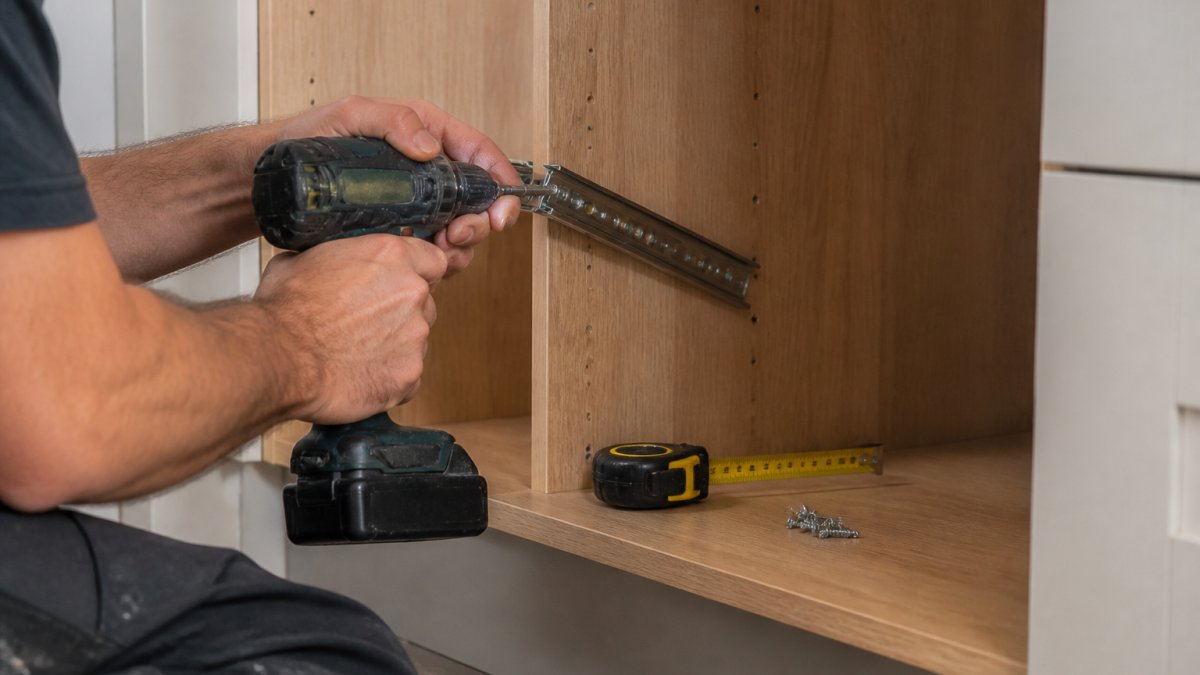
Watch out: over-tightening screws into chipboard strips the thread and the runner will work loose within weeks. Stop as soon as the screw seats.
Converting Cabinet Shelves to Pull-Out Drawers
Fixed shelves convert well, and this is often the cheapest way to gain usable storage.
Pull the shelf out and check how it is fixed. Screwed shelves come away with a driver. Nailed or glued shelves need a jemmy and patience.
For a shelf conversion, a shallow drawer box 100-150mm deep works best for tins, packets and utensils. Deeper boxes suit pans but need stronger runners.
Weight Capacity and Structural Reinforcement
Load-bearing capacity is where most DIY drawer projects fail quietly. A drawer that sags after six months was usually under-specified from the start, not badly fitted.
Heavier-duty runners push higher. The Blum MOVENTO S Blumotion 40 kg Drawer Runners carry 40kg per pair and include tool-free height, side and tilt adjustment.
Reinforce the carcass when the load is heavy:
- Add a plywood base panel under the runner if the cabinet floor is thin
- Fit a side stabiliser bar on wide drawers over 600mm
- Use a rear mounting bracket so the runner is supported at both ends
Troubleshooting and Drawer Front Alignment
Drawer problems often trace back to three causes: an out-of-square carcass, runners fitted at different heights, or a front fixed before the box was adjusted. Work through them in that order. But front alignment deserves its own method, because it is the step where retrofits most often look amateur, and it is the step most guides skip.
Diagnosing the three common faults
If the drawer binds, slacken the runner screws, let the slide find its natural line, then re-tighten. Our guide on how do you replace old cabinet drawer runners walks through the swap step by step.
Watch out: fitting the drawer front before adjusting the box means you will chase the alignment twice. Adjust the box first, then hang the front.
Aligning a new drawer front to an existing door
A challenge on a retrofit is making the new drawer front sit in the same plane and with the same gaps as the door beside it. Work in this order:
- Set the box first. Confirm the drawer box runs level and closes flush with the carcass face before the front goes on.
- Use spacers, not guesswork. Cut two 2mm or 3mm packers from an offcut and trap them between the drawer front and the carcass above and below. This gives a consistent reveal on both sides.
- Clamp, then check. Hold the front in place with a quick-release clamp, stand back at eye level and check the gap against the neighbouring door. Adjust the packers until the reveal matches.
- Fix through slotted holes. Most drawer fronts have elongated screw holes. Drive the screws finger-tight, nudge the front into final position, then tighten.
- Check the door, not just the drawer. If the existing door is out of alignment, the new drawer will look wrong even when it is perfect. Adjust the door hinges first so the reference line is true.
If the existing kitchen uses a different gap, match it, consistency across the run matters more than a textbook figure.
When the front will not sit flush
If the front sits proud at the top or bottom, the runner height is wrong, not the front. If it sits proud on one side only, the carcass is likely out of square, recheck the diagonals before adjusting anything else.
For a face-frame cabinet, the front may need to sit inside the opening rather than over it. Our article on alternatives to side-mount drawer runners covers the hardware options when the frame limits adjustment.
Ordering the Right Drawer Hardware for Your Project
Match the runner to the drawer, not the other way round. Check the load rating against what the drawer will actually hold, confirm the nominal length fits your internal depth, and buy the locking devices your chosen system needs.
A quick specification guide:
| Drawer use | Suggested runner type | Load guide |
|---|---|---|
| Cutlery and utensils | Side-mount ball-bearing, soft-close | Standard duty |
| Pans and heavy cookware | Under-mount or heavy-duty side-mount | 40kg and above |
| Wide drawers over 600mm | Heavy-duty with side stabiliser | 40kg and above |
| Shallow shelf conversions | Standard side-mount | Standard duty |
The Blum MOVENTO S Blumotion 40 kg Drawer Runners offer full extension, integrated soft-close and 40kg capacity. Remember the locking devices set is sold separately, so add it to your order.

Frequently Asked Questions
Can you add drawers to existing cabinets without replacing them?
Yes. Most standard kitchen and furniture cabinets can be retrofitted with drawers or pull-out trays as long as the carcass is sound and there is enough internal depth. You keep the existing cabinet box and doors, then fit new runners and a drawer box or tray inside. The main checks are internal width, internal depth and whether the shelf is fixed or adjustable. If you can add drawers to a solid carcass, the job is usually a few hours per cabinet rather than a full replacement.
What drawer slides are best for existing cabinets?
For retrofits, side-mount ball-bearing runners are the simplest because they screw directly to the cabinet side and drawer box, and they tolerate slight variations in older carcasses. If you want smoother movement and soft-close, under-mount runners such as the Blum MOVENTO range give full extension and tool-free height, side and tilt adjustment. Match the runner to your drawer box depth and expected load. For heavier pull-out trays, choose a runner rated above the weight you plan to store.
How much clearance do drawer slides need?
Side-mount runners need clearance on each side of the drawer box, so allow for this when calculating your maximum drawer box width. Under-mount runners sit beneath the box and need a small gap at the base plus enough internal depth for the runner length. Always check the runner's stated nominal length against your internal cabinet depth, and allow a few millimetres at the back for the mounting bracket.
Can you convert cabinet shelves into drawers?
Fixed shelves can be converted by removing them or working around them, then fitting pull-out trays or drawer boxes on new runners. Adjustable shelves are easier because you can reposition them to suit the runner height. The key is to measure the internal opening precisely and choose a runner length that fits the cabinet depth. Pull-out trays work well for pans and dry goods, while full drawer boxes suit heavier items. Reinforce the cabinet base if you plan to store significant weight.
Adding drawers to existing cabinets is one of the most cost-effective upgrades a kitchen can take, but it rewards accurate measurement and the right runner for the load. FixFit supplies Blum, Hafele, GTV and Sugatsune hardware from stock, backed by a team that works in joinery every day. Browse our drawer runners to match your carcass dimensions, and get your project finished right, first time.
