

DIY Kitchen Renovation Hardware Checklist 2026
Last Updated: November 19, 2026
Quick Summary
A kitchen renovation hardware checklist covers every hinge, runner, handle, foot and fixing you need before fitting begins, ordered in one go rather than last. Count one hinge per door (two for doors over 900mm tall), one handle per door or drawer front, and one pair of runners per drawer. Check compatibility before checkout, as hinges and mounting plates must come from the same system.
- Measure handle centre-to-centre distance, not overall length, to match existing drill holes.
- Blum hinges are sold without mounting plates, so add matching plates to your order.
- GTV soft-close runners carry a 30kg load rating, and drawer width cannot exceed slide length.
- Plinth feet adjust from 125mm to 195mm and carry up to 450kg, but screws are not included.
- Order all handles for one kitchen together, as brushed brass finishes vary between batches.
Table of Contents
- Your Kitchen Cabinet Hardware Checklist for 2026
- Cabinet Hinge Types and What Each One Suits
- How to Measure Cabinet Handles Before You Order
- Drawer Runners, Plinth Feet and the Fittings Nobody Remembers
- Hardware Quantities, Compatibility and Sizing Rules
- How to Identify High Quality Joinery Hardware
- Hardware Costs and What Each Tier Actually Buys
- Ordering Your Kitchen Renovation Hardware in One Go
- Frequently Asked Questions
Your Kitchen Cabinet Hardware Checklist for 2026
A kitchen renovation hardware checklist is a room-by-room list of every hinge, runner, handle, foot and fixing you need before the first door goes back on.
Below is our full DIY kitchen renovation hardware checklist for 2026, with quantities, measurements and realistic costs in GBP. Keep reading because the details we cover here are the ones that decide whether doors hang square and drawers glide, or sag and stick within a month.
Cabinet Hinge Types and What Each One Suits
Start with hinges, because they dictate how your doors sit and close. For standard overlay doors, a soft-close concealed cup hinge is the workhorse choice. Our Blum 71B3550 Soft Close 110° Full Overlay Cabinet Hinge (£3.26) is a full overlay hinge with integrated Blumotion, three-dimensional adjustment and a nickel-plated steel body.
Other types you will meet:
- Full overlay: door covers the carcass edge completely, the modern look
- Half overlay: two doors share a partition, each covering half of it
- Inset: door sits flush inside the frame, least forgiving to fit
- Pie-cut corner hinges: for angled corner cabinets
- Flap and lift hinges: for wall-unit doors that lift upward
If you are still weighing up which style fits your doors, our guide on how to choose cabinet hinges walks through overlay, inset and corner options in more depth. Remember that the Blum hinge above is sold without a mounting plate, so add plates to your order.
How to Measure Cabinet Handles Before You Order
Measure the centre-to-centre distance, not the overall length. That single dimension decides whether a new handle covers the old drill holes or leaves you filling and repainting a door.
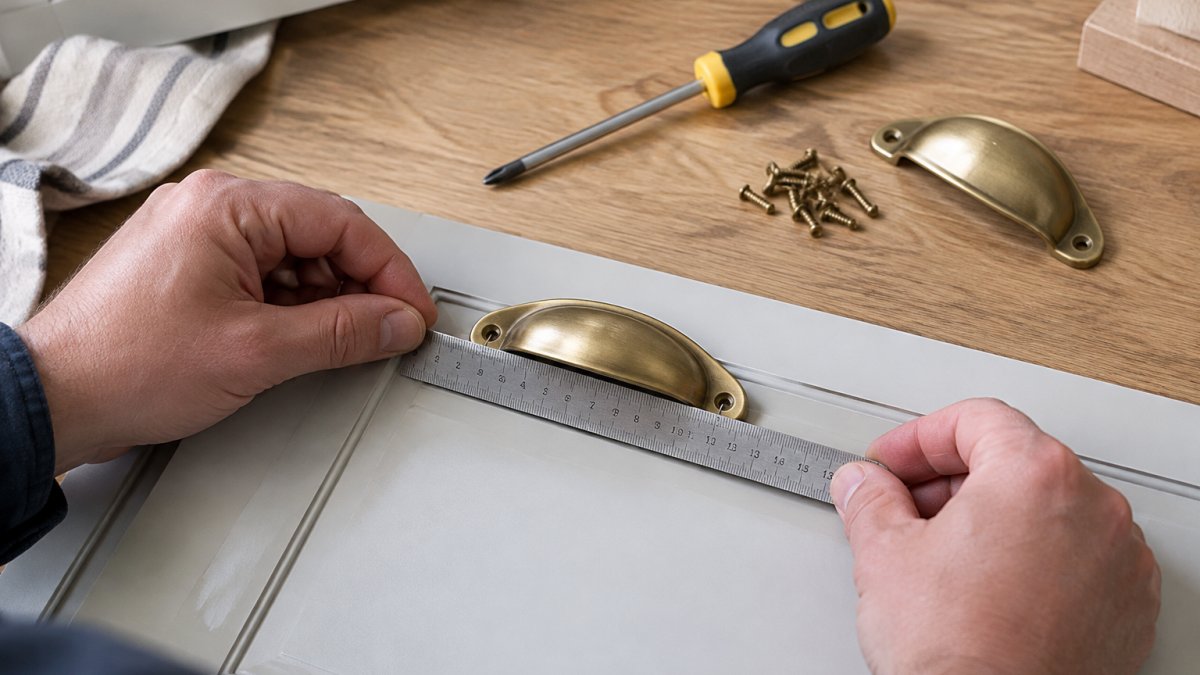
Take a steel rule and measure from the centre of one fixing hole to the centre of the other.
A common pattern is to measure once, order, then discover the handle fouls a neighbouring door or the drawer below. Work through these checks before you buy:
- Centre-to-centre (CTC): the distance between fixing hole centres. Common centre-to-centre spacings include 32mm, 64mm and 96mm. If you are replacing handles, match the existing CTC exactly or plan to fill and re-drill.
- Overall length: the full width of the handle. Allow at least 25mm clearance to adjacent doors, drawer fronts and walls so fingers can grip without trapping.
- Projection: how far the handle stands off the door face. Check that the projection clears any adjacent cabinet when the door opens through 90°.
- Door thickness: most handles are supplied with 25mm screws for 18mm doors. Never let a screw protrude through the inside face.
- Drawer fronts: measure the drawer front height and width, then check the handle does not overlap the runner or the drawer box behind. On deep drawers, a bar handle fitted horizontally is easier to pull than a small knob.
- Appliance and sink clearance: check that handles beside an integrated appliance or sink do not clash with the appliance door or tap when open.
Our Leaf Collection brushed brass cup handle (£7.45) includes 25mm fitting screws and is available in a range of sizes with centre-to-centre spacings of 32mm, 64mm and 96mm. For a fuller walkthrough of handle styles and sizing, see our guide to kitchen cupboard door handles.
Watch out: if you are drilling new holes in a finished door, place a strip of low-tack tape over the drilling point to stop the bit slipping and chipping the finish.
Drawer Runners, Plinth Feet and the Fittings Nobody Remembers
Runners and feet get forgotten until the drawers stick or the cabinets wobble. Budget for them at the same time as the doors.
Our GTV soft-close side-mounted drawer runners (£6.38) are 45mm ball-bearing slides, with a 30kg load rating and full extension on sizes from 400mm to 600mm. They come in lengths from 250mm to 700mm. One rule catches people out: the drawer width cannot exceed the nominal slide length.
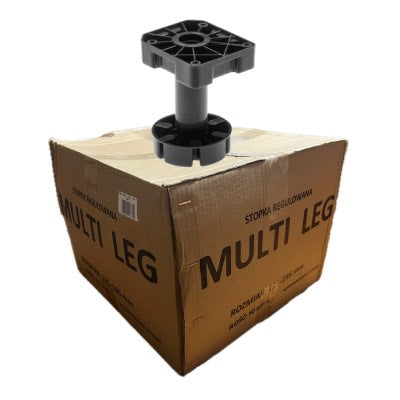
For the base, GTV heavy-duty adjustable plinth feet (£66.60 for a box of 50) adjust from 125mm to 195mm and carry up to 450kg. If you are comparing runner options, our round-up of the best drawer slides for kitchen cabinets covers the trade-offs, and you can buy the adjustable plinth feet box directly.
Hardware Quantities, Compatibility and Sizing Rules
Count before you click buy. A short order means a stalled job and a second delivery charge.
| Item | How to Count | Compatibility Check |
|---|---|---|
| Hinges | One per door, two for doors over 900mm tall | Match overlay type to door style; plate sold separately |
| Mounting plates | One per hinge | Match to hinge brand and series |
| Handles | One per door or drawer front | Centre-to-centre must match existing holes |
| Drawer runners | One pair per drawer | Drawer width must not exceed slide length |
| Plinth feet | One per carcass corner plus mid-supports | Height range must cover your plinth gap |
| Wall hanging plates | One per wall unit | Check hanger type and plate length |
Two compatibility traps to watch. First, hinges and plates must come from the same system: a Blum hinge needs a matching Blum plate. Second, wall units need hanging plates rated for the cabinet's weight; our Hafele 63mm galvanised mounting plate (£0.34) suits a range of wall hangers used on hanging kitchen units.
How to Identify High Quality Joinery Hardware
Quality shows up in the small details, not the marketing. Look for branded mechanisms with stated cycle ratings, plated steel or solid brass bodies, and adjustment screws that move smoothly.
A few checks we would make on any hardware:
- Does the listing state a load rating or cycle test?
- Is the finish plated or applied, and does the seller warn about batch variation?
- Are adjustment ranges given in millimetres?
- Does the hinge specify door thickness limits?
Applied finishes, like our brushed brass handles, can vary slightly from batch to batch, so order all the handles for one kitchen together. And a hinge that offers three-dimensional adjustment saves hours of fiddling at fitting time.
Hardware Costs and What Each Tier Actually Buys
Hardware is the cheapest part of a kitchen and the one that decides how long it lasts. Here is what our own range costs, so you can build a realistic line in your budget.
| Tier | Example | Price | What You Get |
|---|---|---|---|
| Budget fixing | Hafele wall mounting plate | £0.34 each | Galvanised steel, basic hanging support |
| Budget fixing | Hinge repair plate | £0.69 each | Stainless steel, rescues a damaged carcass |
| Mid-range | Blum soft-close hinge | £3.26 each | Integrated soft close, 3D adjustment |
| Mid-range | GTV drawer runners | £6.38 per pair | Soft close, 30kg load, 60,000 cycles |
| Premium look | Leaf brass cup handle | £7.45 each | Solid brass, sculptural finish |
| Bulk buy | Plinth feet, box of 50 | £66.60 per box | 450kg load, adjustable 125-195mm |
| Bulk buy | Carcass screws, pack of 500 | £7.88 per pack | Black phosphate, PZ2, 4.0 x 33mm or 45mm |
Ordering Your Kitchen Renovation Hardware in One Go
Order everything in a single basket. Split orders mean split deliveries, mismatched batches and missing parts halfway through fitting.
Our Hafele plastic drilling jig (£1.98) is designed for Metalla hinges and plates. For a step-by-step fitting sequence, read our tips for installing kitchen cabinet fittings before you start.
Before you place the order, run through this fitting sequence so you know what else you need on the bench:
- Mark out hinge cups. Use the jig or the hinge manufacturer's template. Confirm the cup centre against your hinge specification before marking. Mark the door and carcass before drilling.
- Drill hinge cups. Use the bit size specified by your hinge manufacturer. Set the depth stop so the cup sits flush, not proud. Clear chips as you go.
- Fit hinges to doors. Screw the hinge body to the door, then clip or screw the mounting plate to the carcass. Leave the adjustment screws loose enough to fine-tune later.
- Hang doors and adjust. Use the 3D adjustment on the hinge to set the door gap, height and depth. Aim for an even 2-3mm gap between doors and carcass.
- Fit handles last. Mark CTC, drill pilot holes, then screw handles from the front. Fitting handles after the doors are hung lets you check alignment by eye across the run.
- Fit drawer runners. Fix the runner to the carcass at the height specified by the manufacturer, then fit the drawer box. Check the drawer runs square and does not bind before loading it.
- Set plinth feet and level. Adjust feet so the carcass is level front-to-back and side-to-side, then fit the plinth.
Common DIY errors and how to avoid them:
- Misaligned handles: caused by measuring from the door edge rather than a common datum. Clamp a straightedge across the run and mark all CTCs from that line.
- Unsuitable screws: using long screws in thin doors splits the front or protrudes inside. Match screw length to door thickness and use pilot holes.
- Binding drawers: usually a runner fitted out of level or a drawer box wider than the slide length. Check the runner is parallel to the carcass and the drawer width does not exceed the nominal slide length.
- Doors that will not close: often a hinge plate fitted too far forward or a handle fouling an adjacent door. Adjust the hinge depth screw first, then check handle clearance.
- Split carcass panels: driving screws without pilot holes into chipboard or MDF. Always drill a pilot hole slightly smaller than the screw core.
Watch out: if a hinge cup is drilled too deep, the door face can blow through.
Your renovation will only be as good as the fittings holding it together, and a rushed hardware order is the fastest way to a kitchen that rattles.
Frequently Asked Questions
What hardware do I need for a DIY kitchen renovation?
A full kitchen renovation hardware list covers hinges, drawer runners, handles or knobs, plinth feet, wall mounting plates, carcass screws and any internal storage such as door racks. Add a drilling jig if you are fitting new hinge cups, and hinge repair plates if you are reusing tired carcasses. Count per cabinet rather than per room: two hinges per door, one pair of runners per drawer, and one handle per door or drawer front. Order spares of the small items, as screws and plates are cheap and a second delivery is not.
How do I measure for kitchen cabinet handles?
Measure the centre-to-centre distance between the existing fixing holes, not the overall length of the handle. If you are drilling fresh, pick your handle first and use its stated centre-to-centre figure, then mark and drill with a jig or template. The Leaf Collection cup handle, for example, comes in 32mm, 64mm and 96mm centre-to-centre sizes. Check clearance from the door edge and from adjacent cabinets before committing, and keep the same centre-to-centre across every door so the run lines up.
Are soft-close hinges worth it for kitchen cabinets?
Soft-close hinges remove the door slam that loosens fixings over time, which matters most on wide or heavy fronts. The Blum 71B3550 integrates the Blumotion mechanism into the hinge boss and gives three-dimensional adjustment for lining doors up after installation.
How many cabinet handles do I need?
One handle per door and one per drawer front is the usual approach. Measure every front before ordering rather than counting doors. Add one spare of each size for damage or a later change. If you are mixing knobs on doors and pulls on drawers, count each type separately so you order the right quantity of each.
How can I tell if kitchen joinery hardware is good quality?
Look at the specification rather than the finish. Cycle ratings tell you how long runners will last, and the GTV side-mounted runners are SGS certified for 60,000 cycles with a 30kg load rating. Check material and plating, such as steel with a zinc-galvanised finish on runners or nickel-plated steel on hinges, and confirm the adjustment range. Published dimensions, load figures and compatibility details are the clearest signals to buy against.
